
Gain data-driven visibility into how ERP-based business processes actually run.
Process mining analyzes real ERP execution data to show how processes truly operate.
It replaces assumptions with facts.
What Is Process Mining?
Process mining is a data-driven approach that analyzes how business processes actually run.
It uses event logs from ERP and operational systems.
This makes real execution visible, not assumed.
Process mining is typically used to:
- Visualize real process flows across ERP systems
- Detect delays, rework, and deviations
- Measure cycle time and performance objectively
- Support data-driven process improvement initiatives
Why Process Mining Matters?
In many organizations, processes look efficient on paper.
However, real execution often tells a different story.
Therefore, process mining helps teams detect delays, rework, and hidden variations early.
Key Benefits of Process Mining
Process mining enables organizations to understand how business processes truly operate by using real execution data instead of assumptions.
As a result, teams gain clear visibility, objective performance insights, and faster improvement cycles across ERP-driven processes.
In practice, these benefits allow teams to move from reactive problem-solving to proactive process optimization.
What problem does process mining actually solve?
Process mining shows how your business processes truly work. It analyzes real data from your operations. This helps find bottlenecks, rework, and issues that are hard to see with traditional reports. The insights are detailed and clear. They help your team make quick, fact-based decisions. For example, you can spot inefficiencies and improve them. This approach increases your operational efficiency and performance.
Measurable Process Mining Results
These results are based on typical process mining initiatives using real ERP execution data.
Actual outcomes vary depending on process complexity and data quality.
Cycle Time Reduction
Up to 30–50% reduction in end-to-end process times.
Multiple Fortune 500 companies saved millions in high-volume processes like order-to-cash, procure-to-pay, and claims handling.
Cost Reduction
Achieve 10–25% cost savings in optimized departments.
A global logistics company saved $8 million annually by streamlining order management.
Improved Customer Experience
Cut onboarding times by 25–60%.
Boosts conversion rates by 15%, retention by 20%, and customer lifetime value by 25%.
Strategic Decision Making
Enhance business case accuracy by 20–40% with real performance data.
A telco avoided a $3M investment in an unnecessary process redesign.
Compliance Violation Detection
Detect and correct 90–95% of non-compliant behaviors early.
Prevented fines and losses ranging from $100K to over $1 million in banking and insurance.
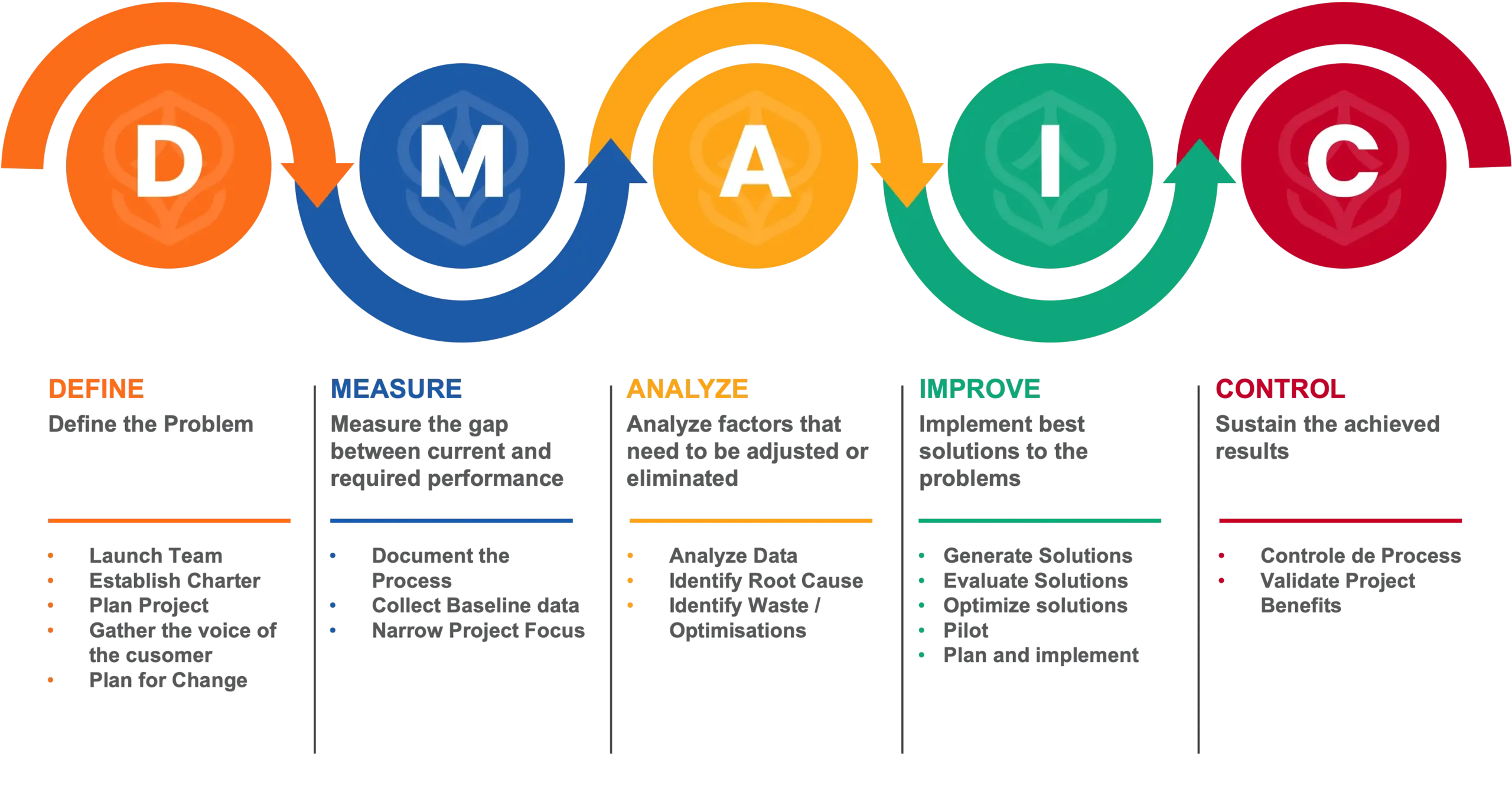
Process Mining Meets Lean Six Sigma + DMAIC
How Process Mining Enhances Each DMAIC Phase
- Define: Use real process data for clear problem definition.
- Measure: Quantify baseline performance with execution logs.
- Analyze: Uncover root causes with data-driven insights.
- Improve: Validate scenarios using historic execution patterns.
- Control: Continuously monitor with process performance metrics.
Three Capabilities,
One Platform
Gain business clarity with Process Modeling, Mining, and Simulation. Traditionally separate, ProcessMind unifies them on a single canvas for faster, data-driven decisions. Experience the power of integrated process intelligence.
Modeling: Map ideal workflows.
Mining: Analyze how processes truly run.
Simulation: Test what-if scenarios before you implement changes.
ProcessMind unifies all three on a single process canvas for faster, data-driven decisions.
In summary:
- Process Modeling defines how a process should work
- Process Mining shows how the process actually works
- Process Simulation tests what happens if changes are applied
ProcessMind combines all three on a single process canvas.
Affordable Process Mining for Growing Teams with Flexible Pricing Plans
ProcessMind is made to be easy to access and affordable for small and mid-sized teams. This helps avoid complex enterprise licenses. It also helps users get the most value from their process mining tools.
Flexible plans are available for all team sizes. These range from basic to advanced. Pick a plan that matches your digital needs. Ensure it allows for growth and scaling.
Essential
$99/month
Step into the world of enhanced efficiency and seamless processes with our Essential tier. Experience the transformative power of our SaaS product, equipped with all the necessary features to kickstart your journey towards operational excellence.
- All modeling features
- All process mining features
- 1 GB Storage / User
Standard
$139/month
Unlock the full potential of process improvement with our Standard tier. It’s designed to empower you with all the functionalities of our SaaS product, enabling you to visualize, optimize, and streamline your workflows with ease and precision.
- All modeling features
- All process mining features
- 1 GB Storage / User
- Process Simulation
- Process Animation
- Process Documentation
Premium
$199/month
Take your process improvement initiatives to new heights with our Premium tier. Ideal for larger organizations looking to scale, this tier provides unrestricted access to all product features, fostering collaboration and driving maximum efficiency across your enterprise.
- All modeling features
- All process mining features
- 10 GB Storage / User
- Process Simulation
- Process Animation
- Process Documentation
- Multiple Tenants
- Data Integration API
- Full Audit Logs
Which Systems Can ProcessMind Analyze?
Process mining works with event logs from:
• ERP systems like SAP, Oracle, Abas, Odoo
• CRM systems such as Salesforce, Zoho, Pipedrive
• Operational systems including MES and RPA platforms
• Custom workflow and BPM applications producing event logs
How MindDX Delivers Process Mining with ProcessMind
MindDX employs a structured, five-step approach to deliver process mining solutions with ProcessMind. This methodology ensures a comprehensive analysis, from initial data extraction to actionable improvement strategies, all within a timeframe that minimizes disruption to your existing systems. We focus on delivering rapid, measurable results. A typical engagement takes 2–4 weeks and does not require changes to existing systems.
This structured approach answers a common question:
“How long does a process mining project take, and what is required to start?”
Supported Source Systems
Where does Process Mining stand vs traditional analysis?
Traditional analysis often uses static reports and assumptions. However, process mining uses real execution data. This data shows actual flows and differences. As a result, it finds root causes quickly. For example, it supports faster and more reliable decision-making.
Typical Process Mining Use Cases
Typical Process Mining Use Cases are:
- Order-to-Cash Analysis
- Procure-to-Pay Optimization
- Production & Operations Transparency
- Compliance & Deviation Detection
- Performance Benchmarking Across Units
These use cases demonstrate where teams can achieve the fastest, measurable impacts. Often, this includes cycle time reduction and cost savings. Moreover, organizations can ensure compliance and benchmark performance effectively.
ProcessMind works effectively even with imperfect or incomplete event log data. As a result, organizations can generate insights without complex ETL processes. This makes the tool both flexible and powerful for diverse operational contexts.
Across these use cases, organizations typically uncover improvement potential of 20–40% in cycle time and throughput within the first analysis phase.
What decisions can process mining support?
Process mining aids data-driven decisions related to process redesign and automation, prioritizing tasks effectively. However, it also enhances compliance and operational performance using real execution data. As a result, organizations can achieve better efficiency and adherence to standards.
Process Mining in One Minute
Process mining analyzes real execution data to demonstrate how processes operate. However, it also reveals inefficiencies, deviations, and opportunities for improvement. As a result, ProcessMind unifies modeling, mining, and simulation to support faster, data-driven decisions.
Frequently Asked Questions
Find answers to common questions about process mining with ProcessMind, including benefits, implementation, and expected outcomes.
Process mining is an analytical approach to discover, monitor, and improve real processes by extracting knowledge from event logs in IT systems.
BPMN stands for Business Process Model and Notation. It’s a standardized graphical notation for drawing business processes (using symbols like rectangles for activities, diamonds for decisions, arrows for flow, etc.). Process mining tools often output diagrams that resemble BPMN models, and some (like ProcessMind) let you import/export BPMN models.
A process model is a representation of a process, often as a flowchart or diagram, showing the sequence of steps, decision points, and flows. In process mining, you get an “as-is” process model derived from data. This can be compared to a “to-be” (ideal) process model designed by the business.
Process discovery is the phase (or type of process mining) focused on automatically generating a process model from event log data, without prior knowledge of the process. It’s about discovering how the process actually flows purely from the data. This is usually the first step in process mining, yielding the raw picture of reality.
ProcessMind is a next-generation process mining platform designed to make process improvement simple, affordable, and accessible. It unifies process mining, modeling, and simulation in one cloud-based tool, so you can upload your data, visualize your processes, and drive improvements—no technical expertise required.
ProcessMind is built for ease of use, fast onboarding, and actionable insights. It offers instant access, no-code setup, and transparent pricing. With ProcessMind, you can quickly discover inefficiencies, monitor compliance, and optimize processes—whether you’re a business user or a process expert.
The timeline depends on the project’s scope and data readiness. A small pilot can deliver results in a few days to a couple of weeks, especially with modern tools like ProcessMind. Larger or more complex projects may take several weeks, mainly due to data preparation and stakeholder alignment.
Commonly mined processes include order-to-cash, purchase-to-pay, invoice approvals, customer onboarding, supply chains, IT service management, and support ticket handling. Any process with digital event logs can be analyzed.
Process mining uses event logs from systems like ERP (e.g., SAP, Oracle, MS, Abas, Odoo), CRM (e.g., Salesforce, Zoho, Pipedrive), helpdesk platforms (e.g., ServiceNow, Zendesk, Freshdesk), BPM workflow tools, and custom business applications. Any system that records process steps with timestamps and case IDs can be a data source.
Process mining is used by finance, operations, procurement, customer service, IT, HR, and compliance departments—anywhere processes are tracked and improved. Both business and IT teams benefit from the insights.
Process mining is applied across industries: manufacturing, banking, insurance, healthcare, logistics, retail, public sector, and more. Any organization with digital processes can benefit from process mining.
Process mining basics involve extracting event data from IT systems, reconstructing the actual process flows, and visualizing them to identify inefficiencies, bottlenecks, and improvement opportunities. It typically requires three key data elements: case ID, activity name, and timestamp. The process includes discovery, conformance checking, and ongoing monitoring for continuous improvement.
Business process mining is the same as process mining. It refers to using data-driven techniques to analyze, visualize, and improve business processes by extracting knowledge from event logs in IT systems. The goal is to gain transparency, optimize workflows, and drive better business outcomes.
Process mining diagrams are visual representations of how processes actually flow within an organization, based on real event data. These diagrams show the sequence of activities, paths taken, bottlenecks, and variations. They help users understand the true process, compare it to the intended process, and identify areas for improvement.
Business process flows are the sequences of steps or activities that make up a business process, from start to finish. They define how work moves through an organization, including decision points, parallel tasks, and handoffs between teams. Understanding business process flows is essential for creating a business process that is optimized for efficiency and ensures consistent outcomes.
Process mining is an analytical approach to discover, monitor, and improve real processes by extracting knowledge from event logs in IT systems. Usually it is spelled as two words: “process mining”.
Unlike traditional BI and reporting tools, process mining analyzes event-level data to reconstruct end-to-end process flows. This makes it possible to identify bottlenecks, deviations, and root causes rather than just reporting aggregated results.
No — ProcessMind uses existing event logs without system changes.
Enterprise process mining platforms are often designed for large-scale, global deployments and typically involve longer implementation cycles, complex data preparation, and higher total cost of ownership.
ProcessMind focuses on fast onboarding, practical insights, and measurable value delivery, making it a strong fit for organizations that want results without heavyweight enterprise complexity.
Yes. ProcessMind is well-suited for small and mid-market organizations that need process visibility and improvement insights without enterprise licensing structures or long project timelines.
Celonis, UiPath Process Mining, and SAP Signavio are widely used enterprise process mining platforms, typically adopted in large-scale environments.
MindDX delivers process mining using ProcessMind with a practical, value-first approach—focused on rapid insights, clear process visibility, and a faster time-to-value based on your scope and data readiness.
Typical outcomes include cycle time reduction, improved process compliance, increased transparency across operations, and data-driven prioritization of improvement initiatives.
Enterprise platforms often have longer deployment and higher total cost of ownership. ProcessMind focuses on fast onboarding, practical insights, and measurable value delivery.
No. Process mining works with imperfect or incomplete event logs and improves insight quality iteratively.
Process owners, operations leaders, IT teams, and continuous improvement professionals use insights for decision-making.