
Unlock Process Excellence with Lean Six Sigma and Process Mining
Lean Six Sigma provides a structured methodology for process improvement.
Process Mining, powered by ProcessMind, adds objective insights from real ERP execution data.
Together, they enable organizations to identify bottlenecks, reduce variability, and drive measurable, sustainable improvements based on facts—not assumptions.
- Faster Improvement Cycles: Identify and eliminate bottlenecks using real execution data.
- Reduced Process Variability: Standardize operations with data-driven insights.
- Evidence-Based Decisions: Replace assumptions with objective process facts.
Why Combine Lean Six Sigma with Process Mining?
How Lean Six Sigma Defines Process Improvement
Combining Lean Six Sigma with Process Mining creates a powerful synergy.
How Process Mining Reveals Real Execution
Process Mining shows how processes actually operate using real execution data.
As a result, inefficiencies and deviations become visible across systems.
This clarity supports continuous improvement initiatives based on facts, not assumptions.
Why the Combination Improves DMAIC Decisions
This integration enables faster root cause analysis, objective performance measurement, and more confident DMAIC decisions.
As a result, organizations achieve shorter improvement cycles, more reliable outcomes, and sustainable operational excellence.
Faster Root Cause Analysis
Objective Performance Metrics
Reduced Cycle Time
DMAIC ENABLEMENT
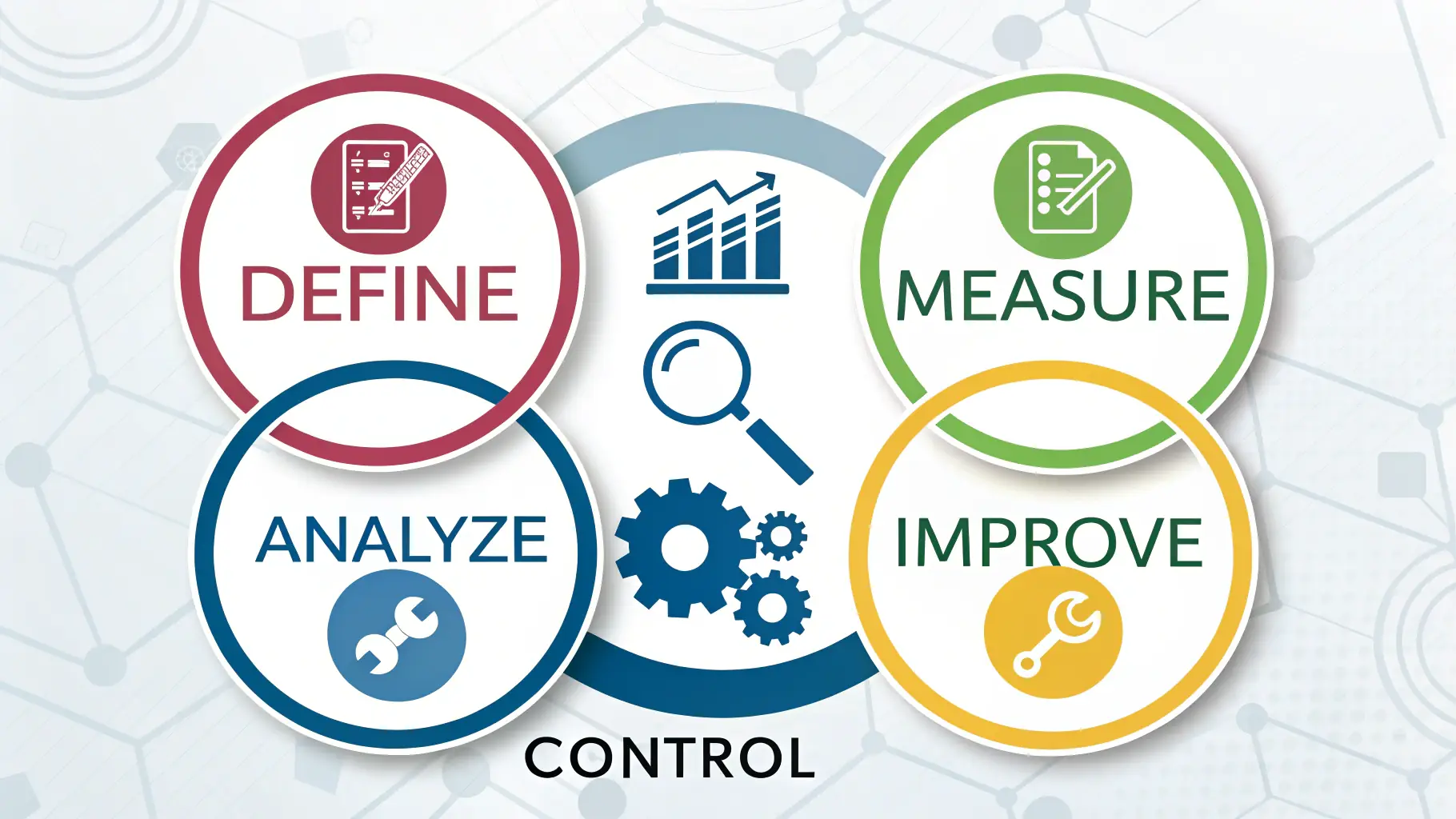
Process Mining Integration Across the DMAIC Cycle
Process Mining enhances every phase of the DMAIC methodology by providing objective, data-driven insights.
It supports teams in defining process scope, measuring actual performance, analyzing root causes, validating improvement actions, and continuously monitoring process stability.
As a result, organizations make more confident decisions and achieve sustainable process improvements based on real execution data rather than assumptions.
Typical Lean Six Sigma Use Cases Enhanced by Process Mining
Explore how Process Mining strengthens Lean Six Sigma across key operational areas.
By analyzing real execution data, organizations gain faster insights, improve compliance, and increase efficiency.
These use cases demonstrate how data-driven process intelligence supports measurable, sustainable improvement across different business functions.
Order-to-Cash Optimization
Procure-to-Pay Efficiency
Production Bottleneck Analysis
These are typical ERP-based processes with high event-log maturity.
Measurable Improvements with Lean Six Sigma and Process Mining
MindDX integrates Lean Six Sigma methodologies with Process Mining to enable measurable and sustainable process improvements.
Our approach focuses on tangible outcomes such as shorter cycle times, reduced process variation, faster insight generation, and improved process stability.
All results are validated using real execution data from operational systems.
30% Reduction in Cycle Time
45% Reduction in Process Variants
60% Faster Time to Insight
Data-Driven Insights for Operational Excellence and Transformation
Lean Six Sigma initiatives enhanced with Process Mining empower leaders with objective, data-driven insights.
This combination provides a clear and factual view of how processes actually operate, helping organizations prioritize initiatives, align stakeholders, and sustain improvements over time.
Rather than relying on theory alone, MindDX focuses on practical decision support grounded in real execution data.
Frequently Asked Questions
Discover answers to common questions about combining Lean Six Sigma with Process Mining to drive measurable and sustainable process improvement.
Process Mining enhances DMAIC projects by revealing how processes actually run based on real execution data.
It uncovers bottlenecks, deviations, and root causes, enabling more focused analysis and data-driven improvement decisions.
No. Process Mining does not replace Lean Six Sigma.
Instead, it strengthens DMAIC by providing objective, data-driven insights that complement traditional improvement methodologies.
To get started, organizations need access to operational data from systems such as ERP, CRM, or other transactional platforms.
No system changes are required; Process Mining works directly on existing execution data.
Timelines vary by use case, but many organizations start seeing measurable insights within a few weeks.
Sustainable improvements typically follow once insights are translated into DMAIC actions.
Lean Six Sigma defines how processes should perform, while Process Mining shows how they actually perform.
Together, they enable faster root cause analysis, objective measurement, and more reliable DMAIC outcomes.
Process Mining supports Define and Measure with factual baselines, Analyze with root cause insights,
Improve with targeted actions, and Control through continuous performance monitoring.
Yes. Process Mining can be used independently to analyze and optimize processes.
However, combining it with Lean Six Sigma provides a structured framework for sustained improvement.
Process Mining works best on processes supported by digital systems, such as order-to-cash, procure-to-pay,
production, logistics, customer service, and finance operations.
Traditional process mapping is based on interviews and assumptions.
Process Mining uses real execution data to automatically reconstruct processes as they truly operate.
Yes. Process Mining enables continuous improvement by providing ongoing visibility into process performance,
deviations, and improvement impact over time.
No. Modern Process Mining tools like ProcessMind provide visual, user-friendly interfaces.
Business and operational teams can analyze processes without advanced data science skills.
By replacing assumptions with objective data, Process Mining enables faster, more confident,
and evidence-based decision-making across DMAIC initiatives.