
12 min read | Updated February 2025 | Applies to: SAP · Dynamics · Oracle · Odoo · ABAS · Any ERP
Executive Summary – TL;DR
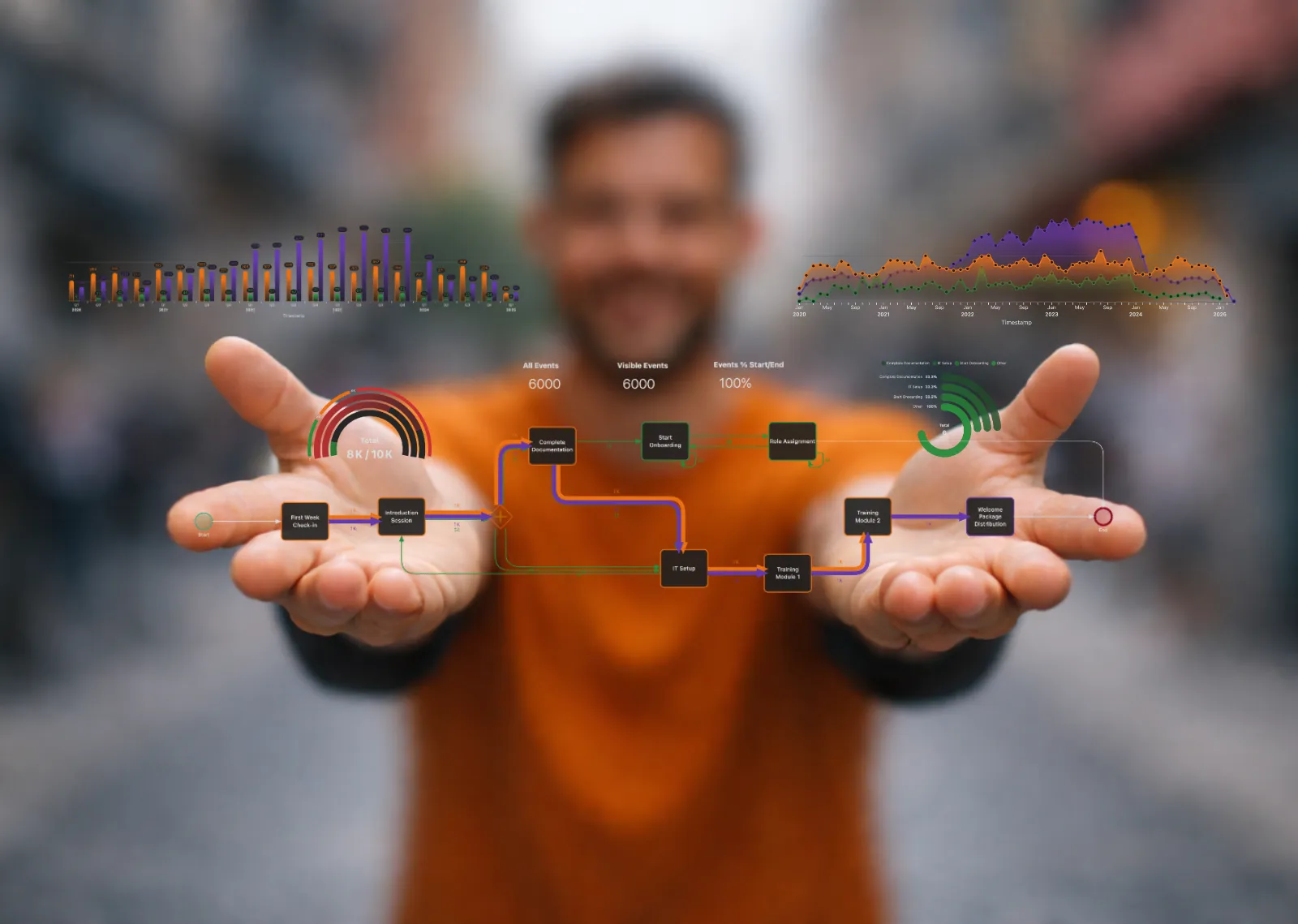
If you run an ERP, you already have the data to improve processes — but not the visibility. Process Mining turns ERP / CRM / ITSM event logs into a factual map of how work really flows. A Digital Twin of an Organization (DTO) uses that operational data to model the current state and explore alternatives. Process Simulation then tests “what-if” changes (approvals, capacity, rules) before you disrupt operations. Together, they form a practical, system-agnostic methodology for mid-market organizations — across manufacturing, logistics, distribution, and services — to maximize ERP ROI and reduce change risk.
Content
- Why ERP process optimization is hard
- What is process mining for ERP?
- What is a digital twin in ERP process management?
- What is process simulation in ERP processes?
- Process mining vs digital twin vs simulation
- The MindDX Process Intelligence Framework
- Use cases across manufacturing, logistics, services
- ROI model + adoption barriers
- How to get started in 2 weeks
- FAQ
Why ERP Process Optimization Is Hard
Most mid-market organizations don’t have an “ERP problem.” They have a process visibility problem.
- Teams believe the process runs one way; the ERP logs prove it runs another.
- Delays hide inside approvals, handovers, exceptions, and rework loops that standard reporting never captures.
- ERP dashboards show outcomes — late orders, delayed invoices, low throughput — but not the actual flow that produced them.
So process improvement often relies on opinions, workshops, and Excel models. And that creates predictable risk:
- You fix one bottleneck and create another downstream.
- You invest in the wrong capacity because the true constraint was never visible.
- You remove a control step and trigger a compliance gap that only appears months later.
Process Mining + Digital Twin + Simulation closes that loop: discover truth → model the system → test change → implement safely. Companies that approach process improvement this way lose significantly less of the 20–30% of annual revenue that industry research attributes to untracked process inefficiency.
What Is Process Mining for ERP?
Process Mining for ERP reconstructs real processes from the timestamped event logs your ERP already generates — not from process maps, interviews, or documentation.
It gives you a factual map of:
- Actual process variants — the different paths work takes through your organization
- Bottlenecks and waiting-time hotspots — where flow slows or stops
- Rework loops and exception paths — cycles that consume resources without adding value
- Compliance deviations — where actual behavior breaks policy
System-agnostic by design
If your ERP generates event logs, process mining works — whether you run SAP, Microsoft Dynamics, Oracle, Odoo, ABAS, or multiple ERPs simultaneously. The methodology reads your data. It does not require a specific platform.
The most important practical point for mid-market organizations: process mining success comes from starting with one high-impact, high-volume process — not attempting enterprise-wide discovery. Order-to-Cash, Procure-to-Pay, and Plan-to-Produce are the highest-yield starting points.
What Is a Digital Twin in ERP Process Management?
A Digital Twin of an Organization (DTO) is a dynamic, data-driven model of how an organization actually operates — built from real event log data — so you can understand current state, observe behavior across conditions, and simulate future states. In plain terms: a DTO is a safe space to test decisions before they reach live operations.
The critical distinction: the difference between “a process diagram” and “a digital twin” is data. A twin reflects real behavior — including delays, exceptions, rework, and seasonal variation — not an idealized process map.
In ERP-driven environments, a DTO typically models the core transactional processes:
- Order-to-Cash
- Procure-to-Pay
- Plan-to-Produce
- Hire-to-Retire (HR process flows)
- Incident-to-Resolution (ITSM)
Gartner now tracks the Digital Twin of an Organization as a distinct market category. By 2027, over 70% of enterprises are projected to integrate digital twin capabilities into their ERP and supply chain systems. Mid-market companies that build this capability now gain a durable operational advantage before adoption becomes standard practice.
What Is Process Simulation in ERP Processes?
Process Simulation uses the discovered process — with its real performance characteristics from historical data — to test what-if scenarios before any operational change is made.
Typical simulation scenarios include:
→ What if we remove or merge one approval step?
→ What if we add capacity to the bottleneck role (finance, planning, dispatch)?
→ What if we change prioritization rules (rush orders, SLA tiers, customer class)?
→ What if we automate exception handling instead of the happy path?
Simulation matters in ERP environments specifically because processes are interconnected. A change that speeds up one queue can overload another. A rule change in procurement affects finance. An approval modification in sales affects production scheduling. Testing first — with your own historical data, not assumptions — is how you eliminate that risk.
Process Mining vs Digital Twin vs Simulation: How They Work Together
The three capabilities are complementary and sequential — not competing alternatives. Understanding where each fits is essential to getting the order right.
| Capability | Process Mining | Digital Twin (DTO) | Simulation |
|---|---|---|---|
| Core question | What actually happens? | How does the system behave? | What happens if we change X? |
| Data source | ERP/CRM/ITSM event logs | Real logs + modeled relationships | Historical data + simulation engine |
| Output | Process map, variants, bottlenecks | Operational model linked to data | Scenario results: lead time, SLA, throughput |
| Best for | Truth, visibility, prioritization | System thinking, cross-process impact | Safe change, investment decisions |
| SME access | High — fast to deploy | Medium — requires modeling | High when combined with mining |
| Operational risk | Zero — read-only analysis | Zero — virtual environment | Zero — no production changes |
Integrated methodology: Mining finds the real process → DTO models it → Simulation tests improvements → You implement with confidence → Continuous monitoring detects new drift.
The MindDX Process Intelligence Framework
To make this practical for mid-market ERP organizations, we apply a five-stage framework that avoids the “big-bang transformation” trap. Each stage proves value before the next begins.
| 1 | Discover | Extract ERP/CRM/ITSM event logs. Reconstruct the real process — not the documented one. Identify all variants, bottlenecks, and compliance gaps. |
| 2 | Model | Build a data-driven process model: your operational Digital Twin. Reflects actual behavior including exceptions, delays, and handover gaps. |
| 3 | Simulate | Test 2–3 improvement scenarios before any operational change. Quantify impact on lead time, SLA, throughput, and resource utilization. |
| 4 | Optimize | Implement the highest-impact, lowest-risk change first. Use simulation results — not assumptions — as the implementation brief. |
| 5 | Monitor | Track improvements, detect new bottlenecks, and measure deviation over time. Process intelligence becomes a continuous operational capability. |
Why this sequence matters
The most common failure mode in process improvement: Mining reveals a bottleneck, leadership makes a structural change based on that diagnosis alone, the change moves the bottleneck to a different department. Simulation exists to prevent exactly this. Never implement a structural change without testing it first.
Use Cases Across Manufacturing, Logistics, and Services
1) Manufacturing: Plan-to-Produce Stability
In discrete manufacturing, Process Mining applied to production order event logs reveals where work waits between operations — not where management assumes it waits. Planned cycle times reflect the designed process; actual cycle times reflect a reality shaped by material availability, machine allocation queues, and manual workaround behaviors accumulated over years.
- Identify where planning changes create execution churn
- Discover rework loops: quality holds, engineering changes, missing materials
- Simulate sequencing rules and constraint-handling changes before touching the production plan
One automotive supplier applied this approach and achieved a 25% improvement in production planning speed and 12% reduction in material waste — without adding headcount.
2) Logistics & Distribution: Order-to-Delivery Truth
Distribution companies frequently discover that their actual order-to-delivery process looks dramatically different from their documented one. Process Mining exposes every exception path, manual intervention, and approval detour that standard reporting masks.
- Expose manual handovers and exception-heavy delivery lanes
- Find where costs hide: returns, re-dispatch, partial shipments
- Simulate staffing and prioritization to reduce delays without over-investing in capacity
A particularly impactful finding in logistics: companies routinely underestimate true per-order cost by 25–40% when relying on accounting data alone. Process Mining reveals the actual labor and time investment per transaction path.
3) Services & Projects: Profitability Leakage
For service companies managing concurrent projects, Process Mining reveals where time and cost leak before they appear in financial reporting. Rework loops, approval bottlenecks, and handover gaps accumulate silently until they show up as margin erosion at project close.
- Uncover approval delays and rework cycles invisible to project management dashboards
- Detect silent scope creep patterns across project portfolios
- Simulate staffing or workflow changes before reorganizing the delivery structure
4) Finance: Approval and Cycle-Time Acceleration
Finance processes generate dense, precise event log data — making them among the most process-mining-responsive areas in any organization.
- Shorten invoice and payment cycles by targeting the true waiting points, not assumed ones
- Simulate removing or merging approvals without breaking controls or triggering compliance gaps
5) ITSM: SLA Compliance as a System
IT service management processes often have visible SLA data but no visibility into why tickets breach. Process Mining reconstructs the full escalation and resolution flow.
- See exactly where tickets stall: handover, escalation, missing information, skill mismatch
- Simulate tiering rules, staffing adjustments, and routing changes to predict SLA improvement before changing anything
ROI Model and Adoption Barriers — and How to Overcome Them
Why adoption stalls in mid-market organizations
Deloitte’s 2025 Global Process Mining Survey identifies management support as the leading barrier — cited by 41% of respondents, up sharply from 26% in prior years. In mid-market organizations specifically, the barrier is rarely the technology. It is almost always:
- Lack of executive ownership — no designated decision-maker, no improvement cadence
- Change resistance — teams distrust consultant opinions; objective data is the antidote
- ROI anxiety — enterprise-grade platform pricing (€100K+/year) makes the methodology seem inaccessible
How the risk is removed
- → Start with one process and one KPI (lead time, SLA compliance, rework rate, or throughput)
- → Use system-agnostic tools and connectors — avoid platform lock-in from day one
- → Prove value in weeks through a Quick Scan, then scale to the next process
Mini scenario: how simulation changes the decision
A manufacturing company identifies through Process Mining that 28% of order-processing delays originate in multi-level approval loops — not production capacity as management assumed.
Instead of immediately removing an approval step, simulation tests three options:
- Merge two approvals into one with conditional exception routing
- Add capacity only to the true bottleneck role in finance
- Change prioritization rules for high-value and time-sensitive orders
Simulation results: 17% reduction in lead time, zero compliance degradation, improved resource utilization in finance. The change that looked risky became a confident, evidence-backed decision.
How to Get Started in 2 Weeks (Quick Scan)
Week 1: Discover
- Select one high-volume process: Order-to-Cash or Procure-to-Pay are the most common starting points
- Extract event logs from ERP (and optionally CRM or ITSM)
- Build the as-is process map and identify the top 3 bottlenecks
Week 2: Simulate and Plan
- Define 2–3 improvement scenarios based on Week 1 findings
- Run simulation and quantify projected impact on lead time, SLA, throughput, or cost
- Deliver a 90-day improvement roadmap with prioritized actions
The internal resource requirement is minimal: one IT contact for data extraction support, one operational process owner for context and validation. The engagement is designed not to disrupt operations while it analyzes them.
FAQ
How does process mining work with ERP?
Process Mining reads the timestamped event logs your ERP already produces — activity name, timestamp, case ID, and optional attributes. It uses these to reconstruct the actual flow of work, revealing variants, bottlenecks, rework loops, and compliance deviations that standard ERP reporting cannot show.
What is a digital twin of an organization?
A Digital Twin of an Organization (DTO) is a dynamic, data-driven model of how the organization actually operates, used to understand current-state behavior and simulate future states before implementing structural change. The key difference from a process diagram: it reflects real behavior, not documented intent.
Can process mining work with any ERP system?
Yes. Any ERP system that generates timestamped event logs can serve as a data source for process mining. This includes SAP, Microsoft Dynamics, Oracle, NetSuite, Odoo, ABAS, Infor, and multi-ERP environments. The methodology is platform-agnostic.
What is the difference between process mining and simulation?
Process Mining discovers and measures the real process as it currently runs. Simulation tests what-if structural changes on that process before any implementation. Mining answers “what is happening”; Simulation answers “what would happen if we change this.”
What is the difference between process mining and BI?
BI aggregates outcome metrics and visualizes results — revenue, average cycle time, defect rate. Process Mining reconstructs the event-level sequence that produced those outcomes, revealing the specific paths, loops, and delays that aggregate reporting cannot show. BI tells you what happened; Process Mining shows you how it happened.
Is simulation always necessary?
Simulation becomes critical when structural changes involve cross-department dependencies, approval layer restructuring, capacity constraint decisions, or SLA compliance risk. For isolated automation of simple manual tasks, Process Mining diagnostic output alone may be sufficient. When the change is structural, simulation is essential.
How quickly do we see results?
Initial process insights — bottleneck identification, variant analysis, rework loop detection — are typically visible within 10–14 days of beginning a Quick Scan, depending on data accessibility. Simulation scenario results are delivered within the same two-week engagement.
What internal resources do we need?
A standard Quick Scan requires one IT contact for event log extraction support and one operational process owner for validation and business context. Total internal time commitment is typically 4–6 hours across the two weeks.
About MindDX Digital Transformation Technologies
MindDX is a digital transformation consulting firm with 20+ years of digital transformation experience across manufacturing, distribution, logistics, and service industries. Our team of 40+ consultants and project managers has guided mid-market organizations through ERP implementations and process optimization engagements in Turkey and international markets. We work with clients running SAP, Odoo, ABAS, Microsoft Dynamics, and multi-ERP environments.
About ProcessMind
ProcessMind is a modern platform for self-service process intelligence, designed to help teams understand, analyze, and improve the way work really happens. With process modeling, mining, and simulation built into one intuitive workspace, ProcessMind makes it easy to visualize workflows, uncover inefficiencies, and test improvements before making changes in the real world. Powered by our Clarity Engine, it delivers clean, human-readable process diagrams that everyone can understand, not just specialists. ProcessMind is built for teams that want actionable insight and real operational improvement, without complexity.