
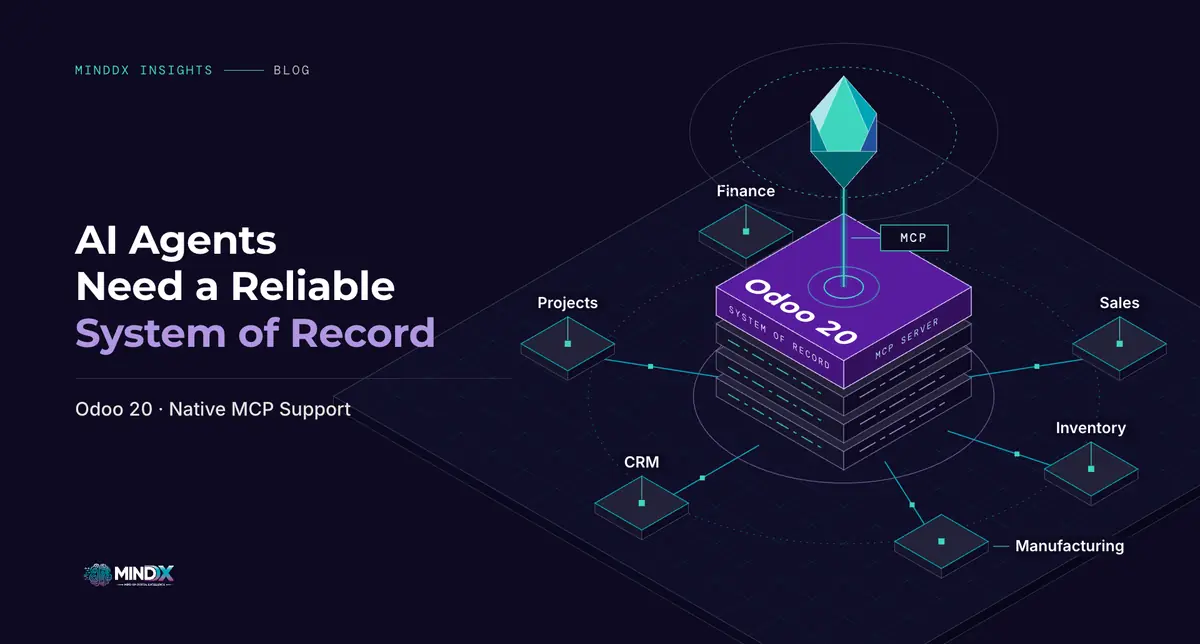
AI agents need more than capable language models to take meaningful action in business operations. They need trustworthy records, well-defined business rules, controlled access and reliable tools. Odoo 20's documented built-in MCP Server is a useful example of how enterprise resource planning systems are becoming accessible to AI applications through standardised interfaces.
AI is moving beyond answering questions
For years, organisations mainly used AI to generate text, summarise documents and answer questions. The rise of AI agents introduces another possibility: systems that can use tools, consult records and carry out bounded tasks as part of a business workflow.
Consider a sales manager asking:
“Review open customer orders, identify those at risk of late delivery, and prepare follow-up recommendations for the responsible teams.”
Understanding the request is only the beginning. The agent also needs access to current orders, inventory availability, delivery information and customer context. If the agent is allowed to modify a record, its identity, permissions and the proposed change become just as important as its reasoning.
What does System of Record mean for AI agents?
A System of Record is the authoritative source for a particular category of business information. An ERP may play this role for purchase orders, inventory transactions, manufacturing orders or financial documents. A CRM or HR platform may be the authoritative system for other domains.
The objective is not necessarily to place all data inside a single application. It is to define which system is authoritative for which data and actions, and then design how AI agents should interact with those systems.
Before an agent proposes or performs an action, it needs access to the correct records. Before any change takes place, the relevant data, access, approval and business-rule checks must be satisfied. This is what separates an impressive demonstration from a dependable operational workflow.
Why Odoo's integrated business applications matter
Odoo brings CRM, sales, purchasing, inventory, manufacturing, accounting, project management and other business functions into an integrated family of applications.
That breadth can make it easier to analyse connected processes. A delivery-risk question, for example, may require more than a sales-order record: inventory, pending purchases and manufacturing schedules may also matter. When those records are available through a coherent system, some integration work may be reduced.
However, an integrated application suite does not automatically mean clean data, sound processes or AI readiness. Organisations still need to examine master data, access rights, process dependencies and the quality of their operational setup.
What is MCP?
The Model Context Protocol (MCP) is an open standard that enables AI applications to interact with external data sources and tools through a common interface. It is neither a language model nor an ERP platform. It standardises part of the communication between AI clients and the systems that expose useful capabilities.
MCP can reduce the need to invent a completely different tool interface for every integration. It does not, on its own, validate data, enforce company policies or guarantee that a requested operation is correct.
Source: Model Context Protocol — official introduction.
What does Odoo 20's built-in MCP Server support?
Odoo's official 20.0 AI MCP Server documentation describes how an external AI client can connect to an Odoo database through MCP.
The documented setup involves generating an API key scoped for MCP, configuring the client to connect to the database's /mcp endpoint, and working with the tools exposed by the server. When a connection is established, the client discovers the tools available to it.
The default set includes tools for discovering accessible models and fields, retrieving initial session context, searching records and grouping data. Additional capabilities, such as creating or updating records, require the relevant tools to be explicitly exposed.
This distinction matters: Odoo 20 documents built-in MCP support; it does not mean every AI agent automatically receives unrestricted access to every ERP record.
For any particular organisation, availability and suitability must also be checked against its deployed version, hosting arrangement, subscription, installed components and permissions.
What could this enable in business operations?
Sales and customer operations. An authorised agent could examine orders and customer context, identify delivery risks and suggest follow-ups. Updating a CRM record is a separate privilege from querying information.
Inventory and purchasing. An agent could review low-stock situations and pending purchase requirements to support planning decisions. Creating or approving a purchase order requires additional controls.
Manufacturing and operations. With access to the appropriate models and tools, an agent could analyse manufacturing orders, materials and delivery commitments together. Changing production records or posting stock movements requires a stricter permission and approval model.
These are potential use cases, not features that automatically work out of the box in every Odoo 20 deployment, and not claims of production-verified MindDX customer implementations.
The real challenge is control, not connectivity
Once AI agents can interact with ERP records, an incorrect action can have consequences beyond an inaccurate answer. Unauthorised financial changes, incorrect inventory movements or unintended customer updates are operational risks.
A responsible architecture therefore needs three foundations:
- Least-privilege access. Give each agent only the data and tools it needs, while respecting user, company and record-level permissions.
- Human approval where it matters. Treat reading data, recommending an action and changing a business record as different risk categories. Introduce explicit approval boundaries for high-impact transactions.
- Traceability and recovery. Record relevant requests, tool use, outcomes and failures; consider duplicate calls, retries and corrective procedures.
There is an important technical nuance in Odoo's documentation: the Readonly Tool flag tells the AI client that a tool is intended to be safe for invocation without explicit approval. It is not, by itself, a technical guarantee that the tool cannot write data. Real safeguards must be implemented in permissions and tool behaviour.
How should organisations start with agentic AI?
Start with a business outcome, not with the largest possible set of AI integrations. Is the priority to detect fulfilment risks, shorten quotation preparation, improve purchasing decisions or provide a clearer operational picture?
Next, assess the current process, record quality, system dependencies and approval requirements. A bounded pilot that reads data and prepares recommendations first may be a prudent initial step. Measure accuracy, exceptions, time saved and user confidence before expanding authority.
A sensible progression is: process and data readiness → permission and risk design → controlled pilot → measurement → selective automation.
The MindDX perspective: Process, data, technology and governance
MindDX approaches digital transformation as more than technology selection or system connectivity. Business needs, operating processes, reliable data and delivery risks need to be considered together.
This perspective is consistent with our Assess / Implement / Transform commercial approach: understand the need and scope, design an appropriate implementation route, and work toward measurable business outcomes.
Odoo 20's MCP Server support is a meaningful technical development. The value an organisation can realise, however, depends on which agents interact with which authoritative systems, using which permissions and under which operating rules. The principle applies beyond Odoo to other ERP and business platforms as well.
Conclusion
Odoo 20 and MCP provide an important path towards connecting AI agents to enterprise records and operational tools through a standard protocol. The future role of ERP is not merely to store information, but to help enable controlled, traceable business workflows involving both people and AI systems.
How ready are your business processes, data and control mechanisms to work with AI agents?