
ProcessMind. Your process as it actually flows, not as it is described.
ProcessMind is a process intelligence solution that brings process mining, BPMN 2.0 modelling, process architecture, simulation and operational dashboards together on one cloud platform. Its purpose is to document, govern, measure and improve how work actually gets done.
ProcessMind’s five-step loop: Discover — the real flow from event data; Document — BPMN model, RACI and SOPs; Unify — process, roles and data in one architecture; Measure — KPIs, conformance and deviations; Improve — try it in simulation, then implement. An arrow from the last step back to the first shows the continuous improvement loop.
Fact sheet
- 2026.09 · expanded API, Enterprise MCP server, AI Assistant (beta)
- ProcessMind B.V. · Deventer, the Netherlands · founded 2024
- Process Foundation · Process Architecture · Process Intelligence · Enterprise
- CSV, TSV, XES, XLSX, Parquet, ORC, JSONL (gzip included)
- Cloud only · AWS Frankfurt (eu-central-1) · no on-premises installation
- UI and documentation in 10 languages, Turkish included · processmind.com/tr
02Who it is for
From the first process diagram to enterprise-wide process intelligence.
The plans are tiered by role: a team that starts with documentation adds the governance and analysis layers as its needs grow. ProcessMind positions itself as a self-service process mining platform for small and mid-sized businesses. The main user profiles:
03Which business problems it solves
There is a process map; it does not match reality.
Most organisations lack a clear view of how their processes really work. The gap usually shows up in these symptoms:
04Core capabilities
Mining, modelling and simulation on one platform.
Automatic discovery, variants, bottlenecks and conformance
The real process flow is derived from event logs, making parallel steps, loops and bottlenecks visible. Variant analysis, conformance rate and deviation frequency against the target model, a case explorer, cross-dataset comparison, process animation and the CURES health score sit here.
Modelling in the browser and the Clarity Engine
BPMN 2.0 modelling with tasks, gateways, events, pools and lanes; version history and comparison, read-only sharing, model quality checks and value stream mapping. The Clarity Engine is the engine that lays out diagrams automatically.
Discrete-event simulation and digital twin
Scenarios are built for resource levels, arrival rates, routing probabilities and queue strategies. Parameters are extracted from mining data, and the model is validated by comparing the result with real data.
Cycle time, throughput, cost and SLA breaches
Pre-built KPI widgets and custom dashboards, with drill-down to the cases behind every chart. A carbon-footprint (tCO2e) column is also supported.
L1–L5 process hierarchy, RACI and approval flow
A process architecture with configurable levels; role library and RACI matrix; a workflow of draft, review, approval and publication; classification and locking. Published processes are presented in an interactive process portal.
SOP and work-instruction packs
Standard operating procedures (SOPs) and work instructions are prepared with AI support and exported as PDF, Word, Excel or image.
Real-time co-editing and comments
Comment threads with @mentions, versioning and search across processes, roles and documents. Process knowledge does not stay in one team’s files.
File formats and incremental loading
CSV, TSV, TXT, XES, XLS/XLSX/XLSB, Parquet, ORC and JSONL (gzip included) are supported. For CSV, Parquet, ORC and JSONL, delta uploads add only the new records.
Screens from the product
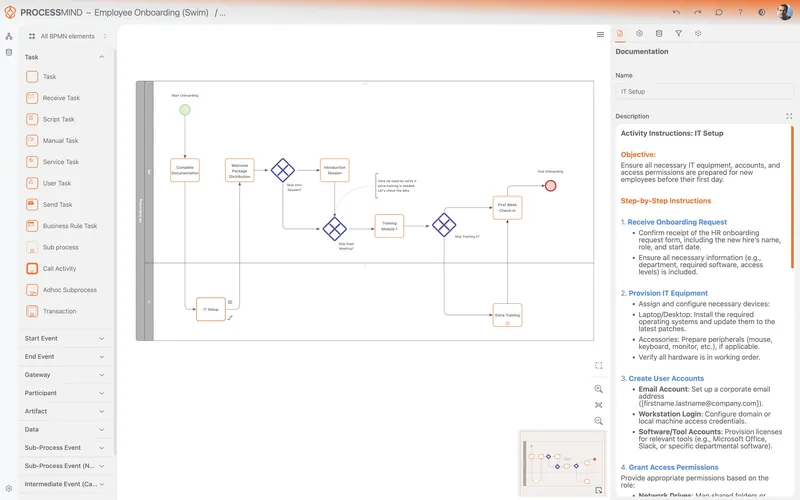
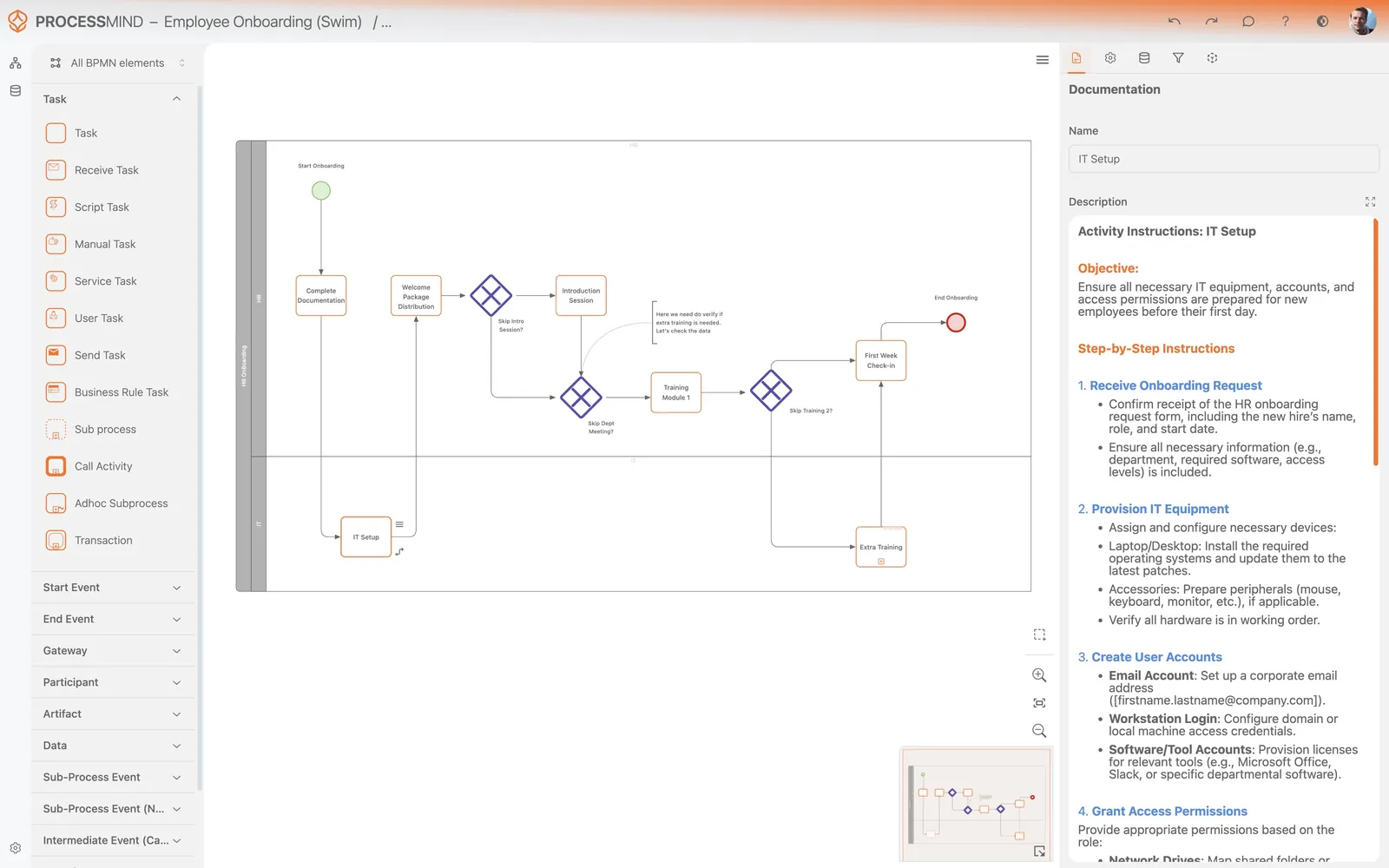
BPMN 2.0 modelling and process documentation on one screen. 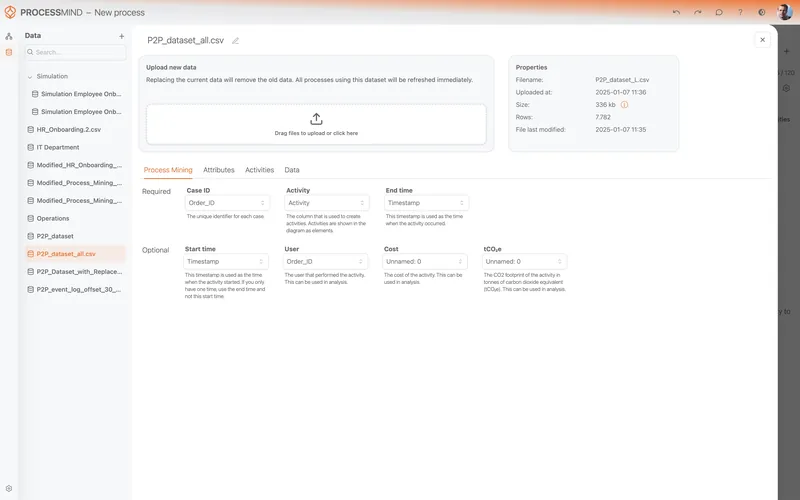
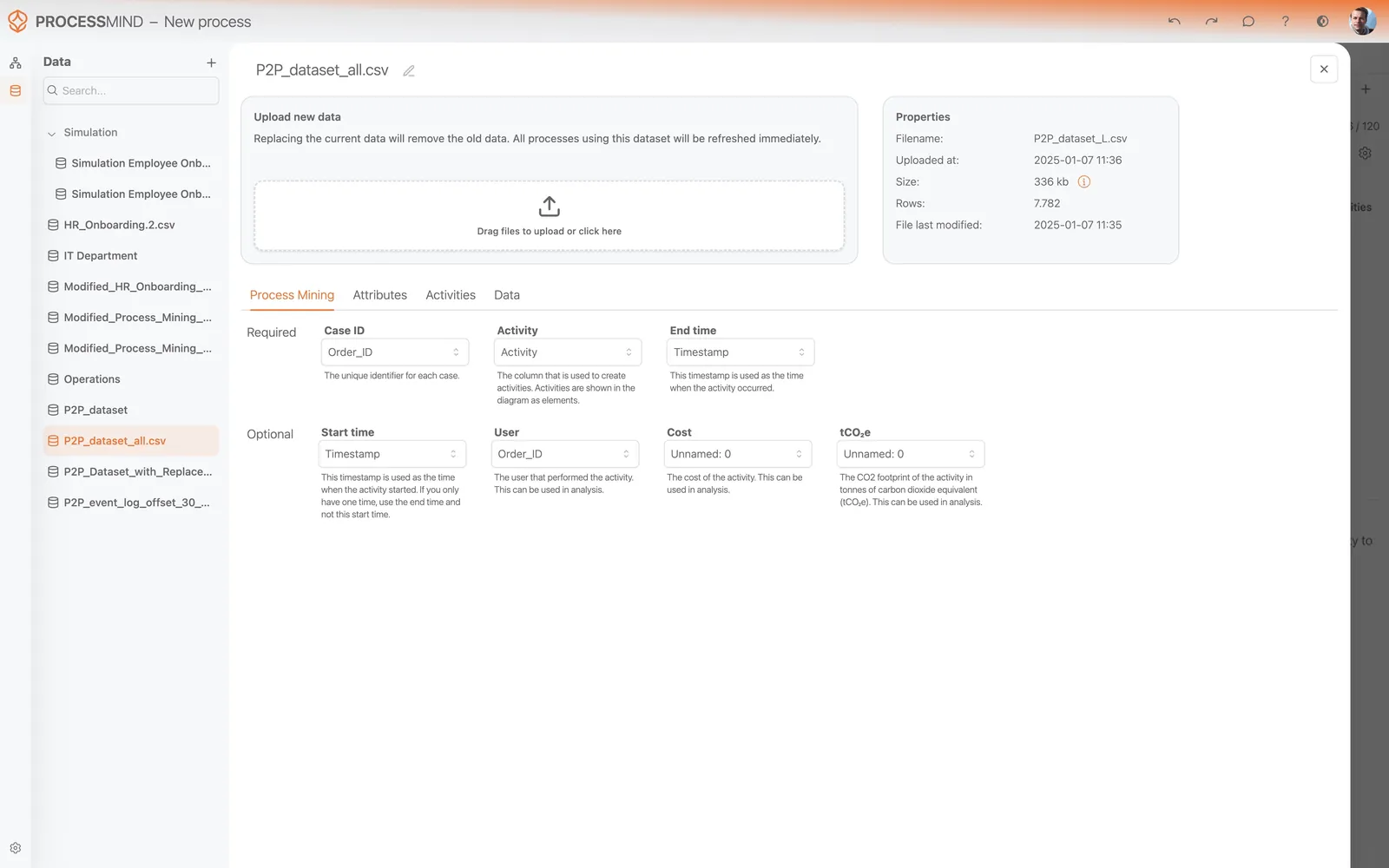
An event log is uploaded; case, activity and timestamp columns are mapped. 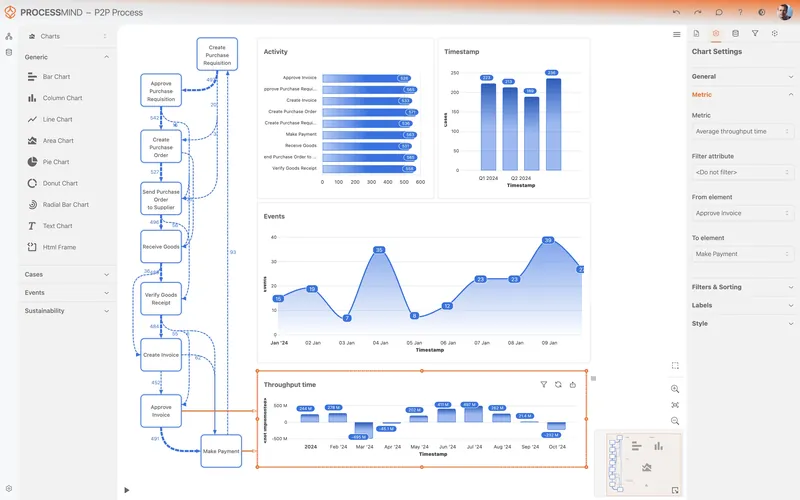
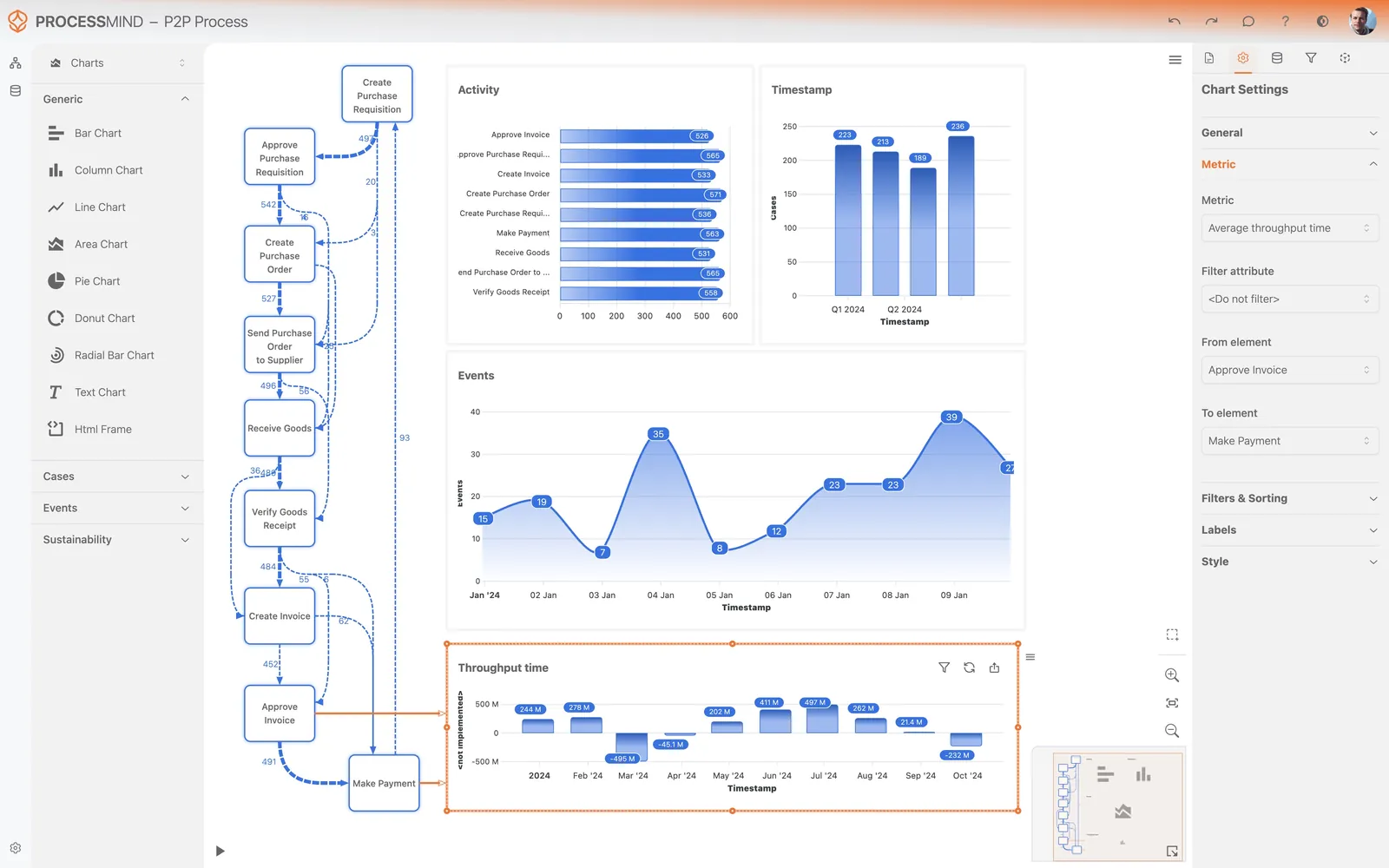
The discovered process flow and throughput-time analysis. 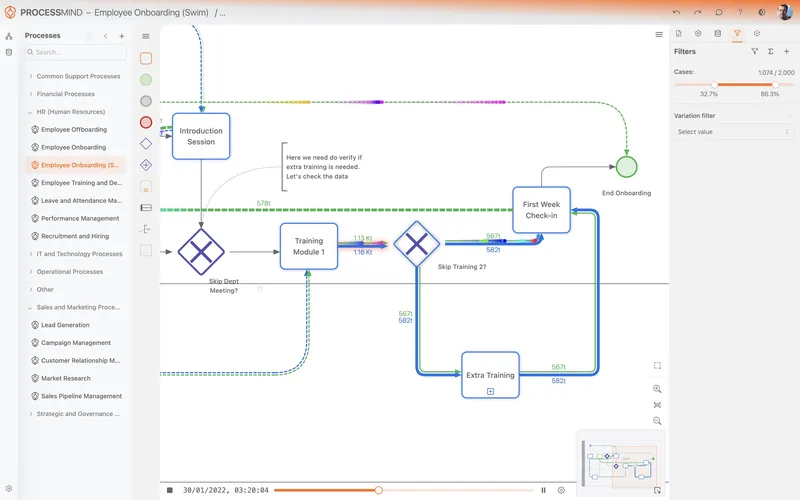
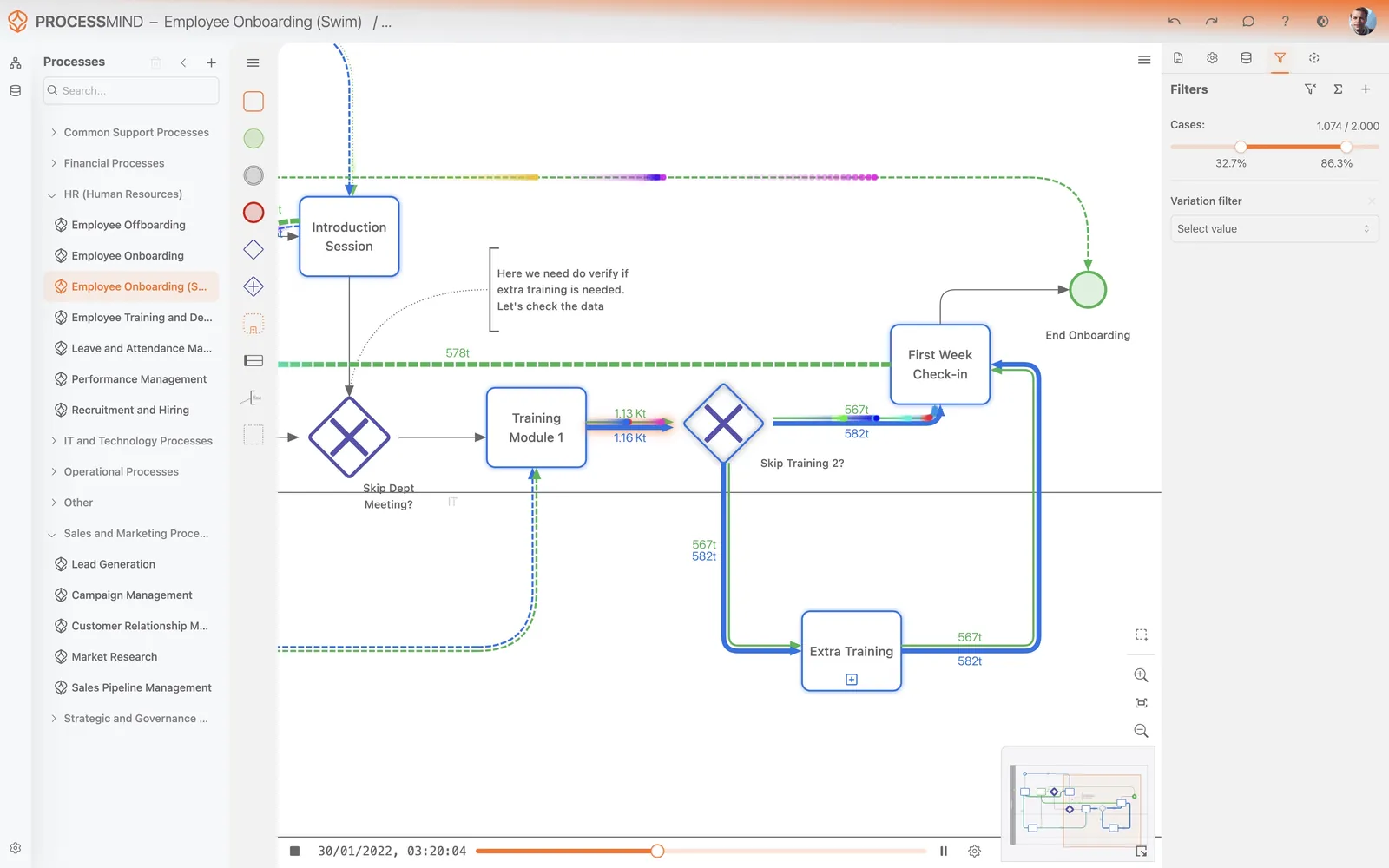
Case flow across the process, followed as an animation.
05How it works
From event log to model, from model to simulation.
A process analysis follows the data model in the documentation, in these steps:
1. Prepare the event log · 2. Upload and map the data · 3. Discover and measure the process · 4. Simulate the target process · 5. Approve and publish · 6. Configure the environment
06Modules and functional areas
Four plans; each builds on the one before.
Process Foundation brings modelling and collaboration, Process Architecture ownership and governance, Process Intelligence process mining and improvement. Enterprise is the layer for enterprise scale and integration.
- Process FoundationBPMN 2.0 modellingcollaborationprocess catalogAI process generationAI Assistant (beta)free viewer seatsauto-layoutversioningSSOEU hosting
- Process Architecture+ process architecturevalue stream mappingdocumentationRACIprocess qualitygovernanceprocess portalRBACaudit log
- Process Intelligence+ operational dashboardsAI insightsvariant analysisprocess compareautomatic discoveryminingsimulationanimationhealth scoresREST APIwebhooks
- Enterprise+ enterprise SSOmultiple tenantsorganisation statisticsembeddingMCP serverAI Knowledge Hubbring your own AI providerpriority support
07Industries
Industry-agnostic, with a clearly stated scope.
ProcessMind publishes use cases for 13 industries, 7 departments and 8 transformation topics; the main industries are listed below. The manufacturing page draws the scope plainly: the solution provides process analysis and operational process simulation, not plant or chemical simulation, and no machine-level or PLC analytics.
08Integration and API
Open interfaces instead of a connector catalogue.
The approach is simple: any system that can export a table can feed ProcessMind, and any system that can send an HTTP request can talk to it. There is no appliance or agent to install on your servers and no connector to maintain.
Inputs: ERP, CRM and service-desk systems that can export a table; file upload as CSV, XES, XLSX, Parquet, ORC and JSONL; REST API v1 with x-api-key (Process Intelligence and Enterprise); XLSX data templates for systems such as SAP, Dynamics 365 and ServiceNow. At the centre, ProcessMind running on AWS Frankfurt (eu-central-1). Outputs: HMAC-SHA256-signed webhooks with at-least-once delivery; an MCP server for enterprise AI applications (Enterprise); BPMN 2.0 XML exchange with Camunda, Signavio and other tools; PDF, Word, Excel, zip and CSV exports.
Start with an export
Data is uploaded as files, in the UI or through the API. The vendor deliberately prefers SQL-based ETL over proprietary connectors; the extraction step has to be planned on the source-system side.
Extraction guides per system
XLSX templates exist for SAP S/4HANA and ECC, Oracle Fusion, Microsoft Dynamics 365, NetSuite, Workday, ServiceNow, Jira, Zendesk, Freshservice, Salesforce and other systems. The vendor states that these templates do not replace an out-of-the-box connector.
v1 · OpenAPI 3.1 · x-api-key
Expanded with release 2026.09: endpoints at api.processmind.com/v1 for organisations, tenants, datasets (presigned and delta upload), BPMN processes, simulations, search, AI prompts and webhooks. JavaScript, Python and Bash examples are on GitHub.
HMAC-SHA256-signed notifications
Events are sent as signed JSON POSTs. Delivery is at least once; deliveryId prevents duplicate processing.
API on the Intelligence and Enterprise plans
The REST API, the data ingestion and simulation APIs, key management and webhooks come with Process Intelligence and Enterprise. The MCP server, embedding and bringing your own AI provider are Enterprise only.
With Camunda, Signavio and other BPMN tools
BPMN 2.0 XML import and export; catalog-level zip and CSV export. Slack/Teams notifications, PowerPoint export and SCIM user provisioning are on the roadmap and not yet available.
09AI and automation
AI proposes; the decision stays with you.
AI is used in five areas: discovery, generation, analysis, recommendation and simulation (AI DISCOVER, GENERATE, ANALYZE, RECOMMEND, SIMULATE). The principle is that the proposal comes from AI and the decision from the user. The AI sub-processor is OpenAI (USA); this belongs in the data-transfer assessment.
From text to a BPMN model
A process described in plain language becomes a working BPMN model; this is available in Process Foundation too. Process architecture, roles and SOPs are also drafted with AI support.
Every change arrives as a proposal first
The assistant introduced with 2026.09 drafts model, documentation and RACI proposals in plain language. Every change is reviewed before it is applied, in a before/after view with «Diff Apply», and a version is saved automatically. Available on all plans; its exit from beta is planned for the last quarter of 2026.
Bottlenecks, rework and deviations
AI automatically surfaces bottlenecks, rework, deviations and inefficiencies in operational data and recommends improvements. Data-structure detection, mapping confidence and simulation settings derived from mining data also sit in this layer.
Enterprise connection to corporate AI
A remote MCP server (x-api-key or OAuth) opens processes, RACI, documentation and analyses to the organisation’s AI applications. With «Bring Your Own AI» you can use your own AI provider and models.
The vendor states the limits plainly: AI supports the work and does not make decisions for you. Process mining measures and models work; it does not execute or automate it. The MCP server does not cover data uploads, mappings or simulations.
10Deployment · security · editions
Cloud only; data in Frankfurt; certifications planned.
A summary based on the security measures (14 Sep 2026), the service level agreement, the data processing agreement and the KVKK position paper:
Process Foundation — model and collaborate: BPMN 2.0, process catalog, AI Assistant (beta), free viewer seats. Process Architecture — own and govern: L1–L5 architecture, RACI, approval flow, process portal, audit log. Process Intelligence — mine and improve: process mining, simulation, process insights, REST API and webhooks. Enterprise — enterprise scale: enterprise SSO, multiple tenants, MCP server, bring your own AI provider.
11Decision criteria
When it is a strong candidate, and when to take care.
The criteria below are derived from the published capabilities and limits; whether they hold for your processes is established in Assess.
When it is a strong candidate
When to evaluate with care
Whether process intelligence is the right category, and from which system and how the event log is extracted, is established with evidence in Assess.
12Questions
What a serious buyer asks.
Answers about the product rest on the vendor’s source; answers about MindDX rest on the approved positioning.
An event log with at least case ID, activity and timestamp columns is enough. The file is uploaded as CSV, TSV, XES, XLSX, Parquet, ORC or JSONL, and the columns are mapped with AI. How the event log is extracted from the source system is scoped separately; the vendor publishes data templates per system for that.
No, but the platform offers both together. Mining derives the real flow from event data; BPMN modelling defines the target process. Conformance checking measures the difference between the two.
Yes. Discrete-event simulation tries resource, arrival-rate and routing scenarios. The digital twin’s parameters are extracted from mining data, and the simulation is validated against real data.
All customer data is held only in AWS Frankfurt (EU); there is no on-premises installation option. The vendor publishes a separate KVKK position paper: it defines itself as a data processor, supports signing the KVKK standard contract and does not claim KVKK certification. The assessment should be made with your legal team, taking into account that the AI sub-processor is in the USA.
Which of the assessment, design, implementation, integration scoping, training and support roles MindDX takes on is written explicitly into the proposal, together with the validated scope.
This page gives no product price, licence, edition fee or duration. They are shared by a consultant after the scope has been validated.
13Related content and sources
Related solution categories
Related insights
All insightsSources and verification
The product information on this page was compiled from the vendor’s official website and documentation, read on the date stated. Edition, plan and capability details can be changed by the vendor; the vendor’s source is authoritative for the current state. No price, licence or duration information is given on this page.
14How to start with MindDX
The road to this product does not start with the product.
The process intelligence decision is made in your processes, not in a demo. Assess shows, with reasons, whether the need is met by standard capability and settles what changes, why and in which order as a validated scope; the implementation proposal comes out of that scope.
ProcessMind × MindDX Assess
A decision that starts from process evidence.
MindDX uses ProcessMind as partner technology in process intelligence and process mining work; ProcessMind is not a module of MindDX Platform. Within Assess, where applicable, our consultants may use ProcessMind to support current-state process visibility from process evidence. Evidence review, findings, scope and the decision are MindDX’s work.
Explore AssessWhich roles MindDX takes on for this product — assessment (Assess · Checkup / Discover / Audit), fit / gap analysis, solution design, implementation, integration scoping, process redesign, training and support — is written explicitly into the proposal, together with the validated scope.
ProcessMind is not a MindDX Platform module and there is no technical integration between the Platform and ProcessMind. The Platform governs selection and readiness with evidence: assessment, requirements, evidence, BPMN design and decision → design → test → acceptance traceability.
MindDX Platform