
abas ERP. The mid-sized manufacturer’s material and money flows in one system.
abas ERP is an ERP system developed for mid-sized companies in discrete manufacturing. It brings the functional areas that run from scheduling to production and from the warehouse to financial accounting together in a three-tier architecture in which customisations are preserved through release upgrades.
Three layers, from the outside in: the customisation layer is where company-specific customisations live (FIP, Report Designer, Workflow Designer, Abas Java Objects). The business layer carries the standard business logic (scheduling, production, sales and purchasing, finance). The database core is abas’s object-oriented database; customisations are not made in the core.
Fact sheet
- ERP · Manufacturing-focused
- Forterro · Forterro Deutschland Abas GmbH, Karlsruhe
- 50–500 employees · discrete manufacturing
- Abas 2024.Q3 · Service Pack 2024.Q3.1 (October 2025)
- On-premises · Abas Cloud Edition (AWS, Germany)
- Abas Connect · REST API · EDI (EDIFACT, VDA, ODETTE, ANSI X.12)
02Who it is for
Mid-sized companies in discrete manufacturing.
abas positions the product for mid-sized companies with between 50 and 500 employees that create value through discrete manufacturing. The production types and user groups highlighted on the product pages are:
03Which business problems it solves
Manufacturing depth and flexibility in the same system.
The problems abas targets are the everyday reality of a mid-sized manufacturer: missed delivery dates, unbalanced stock, critical situations noticed too late, customisations redone at every upgrade and costs that stay invisible.
A five-step flow: a sales order creates a requirement; scheduling automatically assigns this requirement to a supply; the supply is met from stock or by a work order; a continuous availability check updates the status at every event; the result is the delivery date given to the customer.
04Core capabilities
Manufacturing-focused capabilities, from scheduling to finance.
The centre of planning: scheduling
Manages purchasing, sales, service and production with the same requirements planning. Every requirement, for example a sales order, is automatically assigned to a supply (stock or a work order); sales planning is updated on a rolling basis over the short, medium and long term.
Bill of materials and routing in one production list
Material, operations, machines and times are kept in one list; CAD integration transfers the design bill of materials to production. Contract manufacturing, batch optimisation and production planning and control (PPC) are in the same area.
Detailed planning against finite capacity
Calendar, qualification, sequence and priority rules; alternative resources and set-up time optimisation; scenario simulation with Gantt, traffic-light and bottleneck views. The October 2025 Service Pack introduced the new APS generation as Basic and Professional.
From quotation to order, from requisition to payment
An opportunity becomes a quotation, and a quotation becomes an order in a single step; the delivery date is given with an availability check. In purchasing: automatic order proposals, tendering processes and incoming quality inspection according to ISO 9001:2015.
Internal, consignment and external warehouses
Warehouse groups and locations, a stock movement journal, lot and serial tracking; the handheld-terminal solution runs in the browser, independent of hardware. Lot and serial number management was renewed with 2024.Q3.1.
Accounting, consolidation and cost control
Accounts receivable and payable, general ledger, fixed assets, liquidity planning and group consolidation; cost centres, cost objects and project costs. Data is exported to Excel by drag and drop.
More than 20 pre-built dashboards
Cockpits built with the widget library can be embedded in any ERP screen; for advanced analysis, Forterro’s BI product Targit is used.
QM · DMS · Service · Project management
Inspection plans and 8D/4D reports; an audit-ready archive and OCR; mobile service that works offline; project management with critical path and forward/backward scheduling.
Images from the product
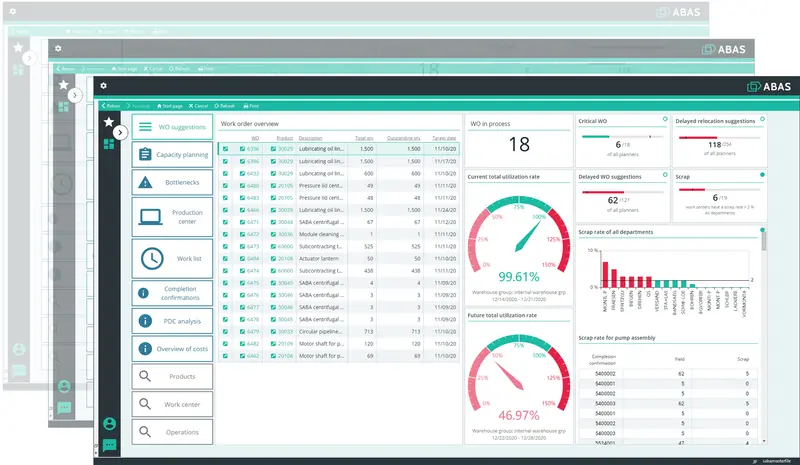
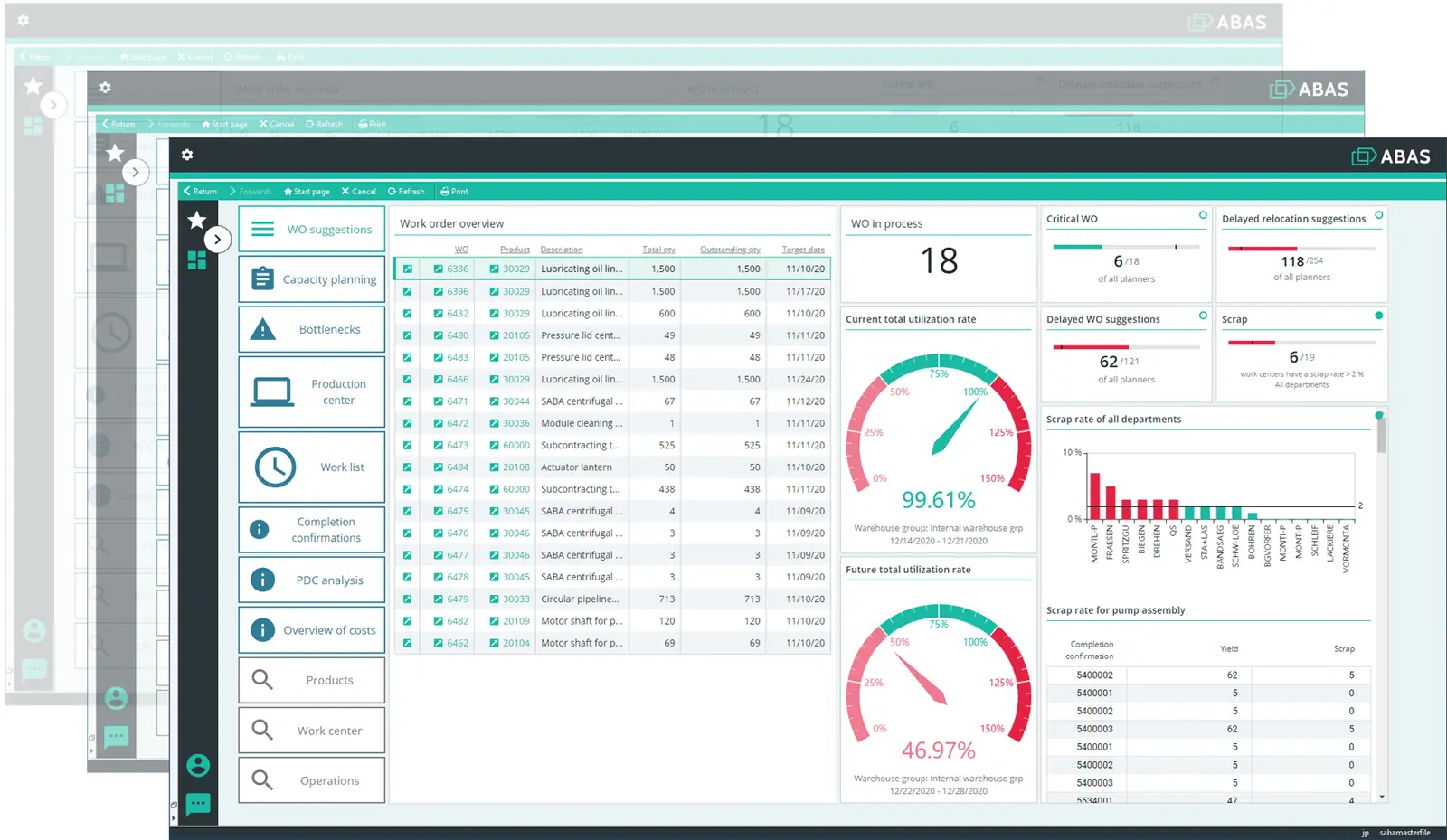
Production dashboard: work orders, capacity and performance on one screen. 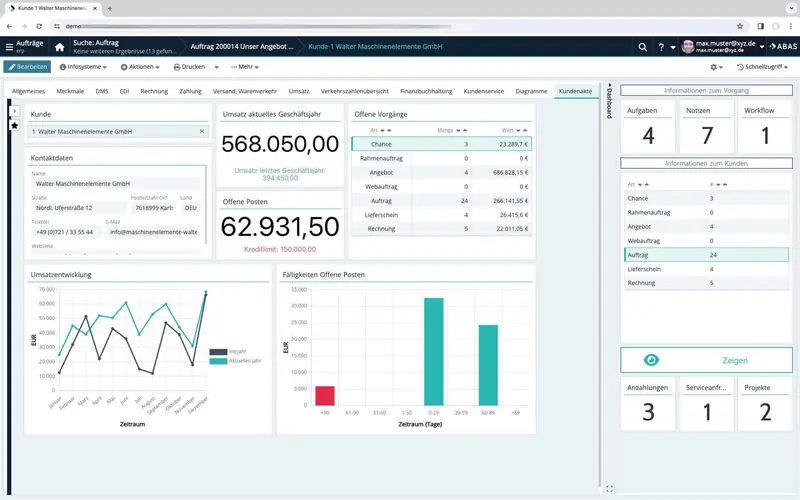
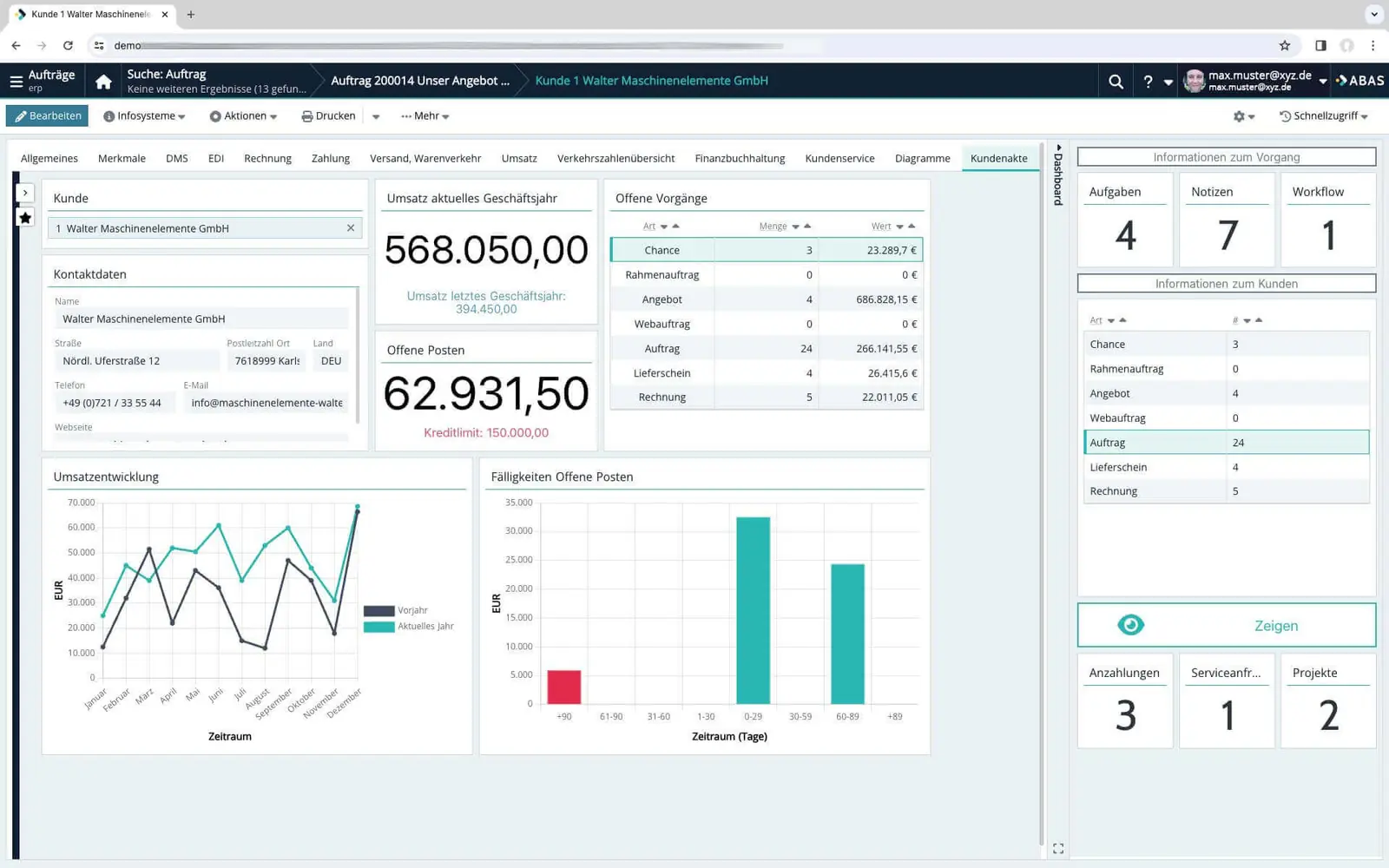
Customer file in the web client: from order to finance on one record.
05How it works
Scheduling at the centre, customisation outside the core.
abas works on two principles: scheduling responds immediately to every event and keeps the plan current; customisations sit in a separate layer and are therefore preserved through release upgrades.
1. Scheduling drives the plan · 2. Three-tier architecture · 3. Customisation tools · 4. Workflow Designer · 5. Web Client and mobile · 6. Implementation with GIM
06Modules and functional areas
Functional areas from production to finance.
The functional areas on abas’s product page are listed below under the names the vendor uses. The detailed scope of each area can be reviewed via the corresponding link on the product page.
- SchedulingScheduling: requirements and supply planning
- ProductionProduction lists, PPC, CAD integration
- Financial accountingReceivables, payables, general ledger, fixed assets
- CostingPreliminary, concurrent and final costing
- CustomizationNo-code/low-code tools, FIP, Java Objects
- SalesCustomer records, quotations, orders, shipping
- PurchasingSuppliers, pricing, tendering, delivery
- ControllingCost centres and cost objects
- ReportingKey figures, Excel, BI templates
- Connectivity & IOTAbas Connect, REST API, connectors
- Order processingOrder processing
- Advanced planning and scheduling (APS)Detailed planning against finite capacity
- DashboardsMore than 20 pre-built dashboards, widget library
- Document managementAbas DMS, OCR, audit-ready archive
- MultisiteMultiple companies, languages and currencies
- Mobile applicationsCRM and field service templates
- Plant data collection (PDC)Collecting production data from the shop floor
- eInvoiceZUGFeRD/Factur-X, XRechnung, MyForterro E-Invoicing
- Automotive and SupplyCall-off and JIT delivery schedules
- EDIEDIFACT, VDA, ODETTE, ANSI X.12
- ServiceService centre, offline mobile service
- Service assignment planningGraphical service planner
- Project managementAbas PM, critical path, budget
- QMInspection plans, 8D/4D, supplier evaluation
- WarehouseWarehouse groups, handheld-terminal solution, stocktaking
07Industries
Core industries, led by metal, automotive and machinery.
abas defines its core industries as metal, automotive, machine and plant engineering, electronics, medical device manufacturing, and rubber and plastics technology, and publishes a separate industry page for each.
08Integration and API
Abas Connect, REST API, EDI and ready-made connectors.
abas positions connectivity to the IT landscape as one of the product’s core features. The integration tool that comes with the standard edition and the documented interfaces are:
Five connection routes converge in abas ERP: interface configuration without code through Abas Connect; the REST API, providing real-time read and write with the core logic; EDI with EDIFACT, VDA, ODETTE and ANSI X.12; DMS, MS SQL and PDM connectors; e-invoicing with ZUGFeRD, Factur-X and XRechnung. In the Forterro ecosystem, Prodaso provides machine and shop-floor data through the Prodaso Connector, and Targit provides business intelligence with MyForterro single sign-on.
Configuring interfaces without writing code
Interfaces are configured in a graphical environment, without programming. CRM, machine controls, warehouse management software and autonomous systems are connected this way; product tracking with RFID is supported.
Real-time read and write
The REST API provides real-time read and write access to data without bypassing the ERP core logic and company-specific customisations.
DMS, MS SQL and PDM
Connection to third-party DMS; incremental data transfer to MS SQL Server; a standard connector for PRO.FILE and keytech, and a bidirectional connection with other PDM systems. A CAD connection can also be set up without PDM.
EDI including automotive messages
EDIFACT, VDA, ODETTE and ANSI X.12; VDA 4984 forecast schedules, JIT call-offs and picking lists.
European e-invoice formats
ZUGFeRD/Factur-X and XRechnung formats; sending and receiving run through MyForterro E-Invoicing. The official sources contain no statement on Turkey’s GİB e-document infrastructure.
Prodaso and Targit
Forterro acquired the production data solution Prodaso in June 2024; release 2024.Q3.1 brought the Prodaso Connector. Targit BI is embedded in the interface; single sign-on (SSO) requires MyForterro access.
09AI and automation
A three-level AI strategy; Prodaso for production.
abas’s AI strategy has three levels: operational efficiency, tactical AI and strategic AI. The functions in use today and the topics on the roadmap are kept apart below.
Pattern and anomaly detection, prediction models
Pattern and anomaly detection in production data, multi-parameter correlation analysis, probability predictions for quality and equipment failure, master data improvement. abas states that the first solutions have been integrated into the ERP and are in live use.
A use case, not a published function
Quotation text in sales, account recognition in accounting, customs tariff numbers in foreign trade, 8D reports in quality, C-part and supplier quality analysis in purchasing. abas presents these as example scenarios.
Topics in development
Predictive analytics, automatic action recommendations, context-sensitive help and self-learning workflows. The MyForterro platform is stated to be based on current standards such as MCP.
Automation that runs today
Workflow Designer, automatic invoice processing, automatic purchasing proposals and automatic optimisation runs in APS.
abas states that it aims to provide AI functions in a transparent, auditable and GDPR-compliant way. The topics on the roadmap are in development; in a purchasing decision they should not be assessed as published functions.
10Deployment · security · releases
On-premises or Cloud Edition.
abas offers two operating models: an on-premises installation in your own infrastructure, or Abas Cloud Edition, operated by the vendor. The choice should be made according to IT capacity, data residency requirements and the customisation plan.
11Decision criteria
When it is the right candidate, and when to take care.
The criteria below are derived from the capabilities and limits abas publishes; whether they hold for you is established in Assess.
When it is a strong candidate
When to evaluate with care
Whether abas ERP is the right solution for you, and in what scope it is implemented, is established in Assess, based on your evidenced processes.
12Questions
Frequently asked before a decision.
Answers about the product rest on the vendor’s official sources; for the current state, see the sources section.
abas’s official sources contain no statement on a Turkish interface or on Turkish fiscal localisation, including GİB e-documents. abas states that country-specific requirements are met through its international partner network. Language and regulatory scope should be confirmed in writing at proposal stage, together with the responsible party.
According to abas, yes: because customisations are made not in the core but in a separate outer layer, they are preserved through release upgrades. Which customisations stay in this layer should be determined at the design stage.
There are two routes: an on-premises installation, or Abas Cloud Edition, which runs single-tenant on AWS with its data stored in Germany. The right option is established in Assess, together with your IT capacity, your data residency requirements and your customisation plan.
The main release is Abas 2024.Q3. Service Pack 2024.Q3.1, published in October 2025, brought the new APS generation as Basic and Professional, the Prodaso Connector, renewed lot and serial number management and CO₂ tracking. abas does not publish its release schedule.
Prodaso is a production data and AI solution that Forterro acquired in June 2024. abas provides the commercial and planning data, Prodaso the shop-floor and machine data; the two products are connected with the Prodaso Connector. The technical scope of the integration is determined separately in the project.
As an abas partner, MindDX sells licences and provides implementation services for abas ERP. Assessment, design, integration scoping, training and support are also among the roles it can take on; which of them it takes on in your project is written explicitly into the proposal, together with the validated scope.
This page gives no product price, licence, edition fee or duration. They are shared by a consultant after the scope has been validated.
13Related content and sources
Related solution categories
Related insights
Sources and verification
The product information on this page was compiled from the vendor’s official website and documentation, read on the date stated. Edition, plan and capability details can be changed by the vendor; the vendor’s source is authoritative for the current state. No price, licence or duration information is given on this page.
14How to start with MindDX
The road to this product does not start with the product.
The ERP decision is made in your processes, not in a demo. Assess shows, with reasons, whether the need is met by standard capability and settles what changes, why and in which order as a validated scope; the implementation proposal comes out of that scope.
As an abas partner, MindDX sells licences and provides implementation services for abas ERP. Which roles MindDX takes on in your project — licence, assessment (Assess · Checkup / Discover / Audit), fit / gap analysis, solution design, implementation, integration scoping, process redesign, training and support — is written explicitly into the proposal, together with the validated scope.
abas ERP is not a MindDX Platform module and there is no technical integration between the Platform and abas ERP. The Platform governs selection and readiness with evidence: assessment, requirements, evidence, BPMN design and decision → design → test → acceptance traceability.
MindDX Platform