
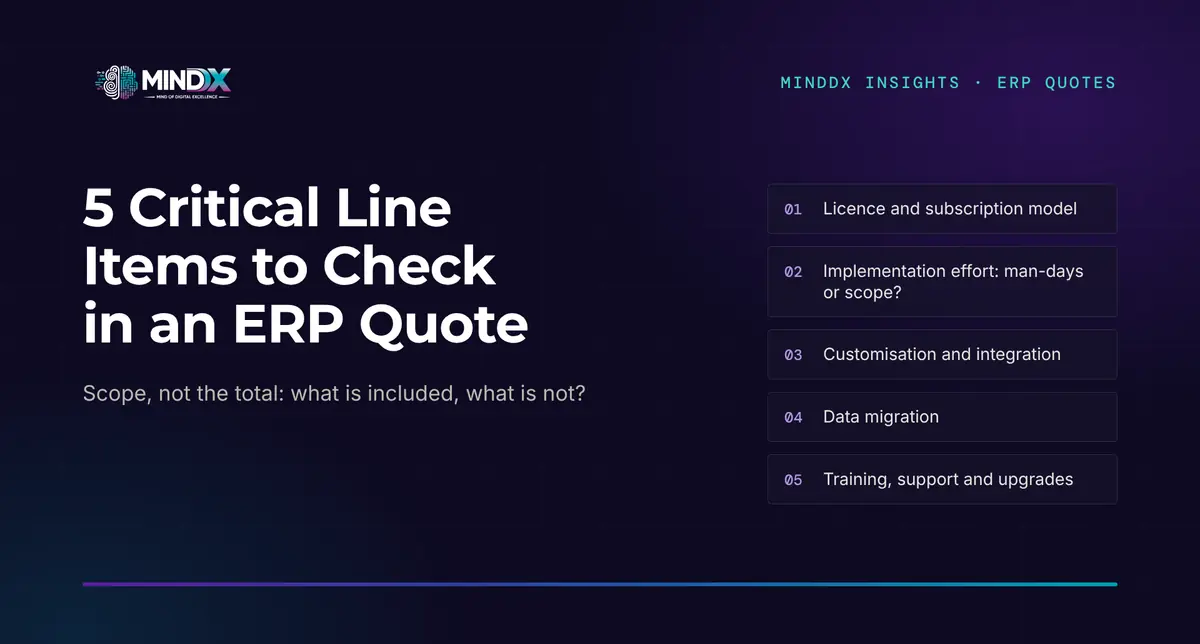
In short: comparing ERP quotes on the total alone often means mistaking the most incomplete quote for the best one. Five line items make the comparison meaningful: the licence or subscription model, implementation effort, customisation and integration, data migration, and training, support and upgrades. For each of them, the question «what is included, what is not» should have a written answer.
When an ERP project starts, several quotes usually arrive. Placed in one table, quotes with different scopes, units and assumptions are easily compared in a misleading way: an item included in one quote may sit under «optional» in another and be missing from a third. This article looks at the five critical line items that make quotes comparable, and at the questions to ask about each.
1. Licence and subscription model
The first item is the terms on which you will use the software. A perpetual licence, an annual subscription or a per-user cloud subscription each create a different cash flow and different obligations. With a cloud subscription (SaaS), running the software is the provider's responsibility; with an installation on your own servers, the infrastructure and its maintenance become yours.
Questions to ask: How are user types defined (full user, limited user, read-only)? Are modules priced separately? How is the fee set when the subscription renews? Does the licence agreement state clearly the terms for using, copying and transferring the software?
2. Implementation effort: man-days or scope?
Implementation services are where quotes differ most. In a quote based on man-days, that is billing per consultant day, the total is an estimate: as the scope widens or decisions are delayed, the number of days, and with it the fee, goes up. In a quote priced on scope, the fee is the price of work defined and validated in advance.
Whichever model is chosen, the scope has to be written down and measurable: Which processes, which companies and sites, which reports, which integrations are included? Describing the processes in a shared language such as BPMN makes the line between «in scope» and «change request» clear.
3. Customisation and integration
Development for needs the standard software does not meet, and the connections to other systems, should appear in the quote as separate lines. These items set not only the cost of the first implementation but also the maintenance load that comes back with every upgrade.
Questions to ask: Which needs require custom development, and why can standard functionality not meet them? Who owns the code that is developed, and who maintains it? Are the connections needed for electronic documents such as the e-Invoice and the e-Waybill included in the quote? Who steps in when an integration breaks?
4. Data migration
Which data moves from the old system to the new ERP system, who cleanses it and how many trial loads are run are often left vague in quotes. Yet data migration is the item that most directly affects the timing of go-live.
What the quote should make clear: the types of data to be moved (master data, open balances, historical transactions), who is responsible for cleansing and mapping the data, and the trial loads with their acceptance criteria. If the data being moved includes personal data, the contract should also state that it is processed in line with the Turkish Personal Data Protection Law (KVKK).
5. Training, support and upgrades
Go-live is not the end of the project but the start of daily use. If user training, the post-go-live support period and upgrades are not defined in the quote, these needs come back as extra costs in the first months.
Questions to ask: Who is trained, in what format and with what documentation? Through which channels, and with which response times, is support provided after go-live? Are upgrades included in the fee, and who moves customisations to the new release?
Quote comparison table
Filling in the table below for each quote before putting them side by side makes the missing items visible:
| Line item | What you should see in the quote | Question to ask |
|---|---|---|
| Licence and subscription | User types, modules, renewal terms | What happens when the number of users or modules changes? |
| Implementation effort | Written scope, pricing basis, change request process | How is any work outside the scope priced? |
| Customisation and integration | List of developments, list of integrations, code ownership | How are these developments carried through an upgrade? |
| Data migration | Data types, cleansing responsibility, trial loads | Who accepts the accuracy of the data, and against which criteria? |
| Training, support and releases | Training plan, support channels, upgrade policy | Which support after go-live is included in the fee? |
Making quotes comparable
The only fair way to compare different quotes is to have all of them prepared against the same scope. When each bidder reads the scope its own way, what you compare is assumptions, not prices.
In the MindDX approach the quote rests on a validated scope. Assess validates the need and the current state with evidence and produces the Validated Scope; Implement is then priced on that scope, not on man-days. For choosing the software itself, see our article on the five critical capabilities in an ERP selection. If you are considering public support for your project, we recommend checking the current KOSGEB support programmes on the agency's official list.
Conclusion
The lowest total is not always the lowest cost. When the question «what is included, what is not» has a written answer for licence, effort, customisation, data migration and support, the quotes become truly comparable.
Would you like to assess your quotes against a validated scope?
Sources
- NIST SP 800-145 — The NIST Definition of Cloud Computing
- European Union — Directive 2009/24/EC on the legal protection of computer programs (EUR-Lex)
- Object Management Group — Business Process Model and Notation (BPMN) 2.0
- Turkish Revenue Administration (GIB) — e-Document portal (in Turkish)
- Personal Data Protection Authority (KVKK) — Personal Data Protection Law
- KOSGEB — list of support programmes (in Turkish)