
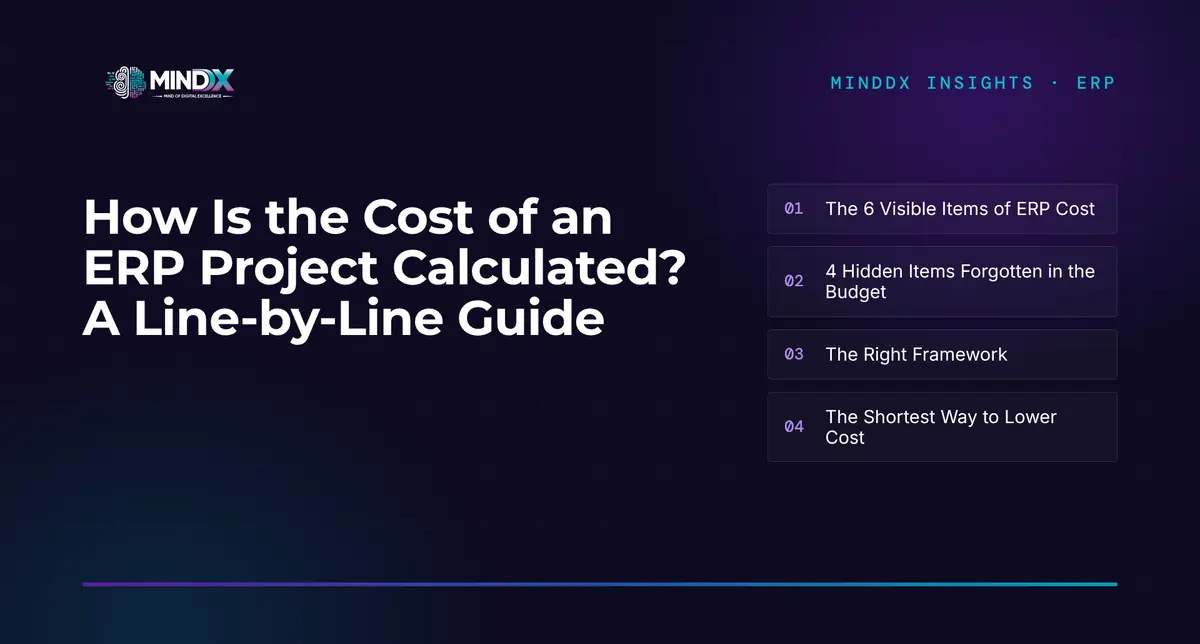
"How much does an ERP project cost?" — the first question of every journey that sets out to select software. The trouble is that this question is usually framed wrongly: the figure discussed at the proposal table is generally only the licence and consulting line; yet a significant part of the total cost is hidden in other lines. This guide breaks ERP cost down line by line: the six visible items written into the budget, the four hidden items forgotten in most budgets, and the total cost of ownership (TCO) view that brings them all together in a single framework.
The 6 Visible Items of ERP Cost
1. Licence or subscription
Varies according to the number of users, the modules and the hosting choice (cloud/on-premises). It is usually the easiest item to compare — and precisely for that reason, proposal comparisons often get stuck here. The licence is the visible tip of the iceberg.
2. Implementation and consulting
The work of analysis, configuration, testing and commissioning. In most projects it is many times higher than the licence, and the pricing model (man-days, fixed scope or outcome-based) directly determines the overall risk.
3. Data migration and cleansing
Weeding out duplicate customer account records, standardising stock codes, completing missing fields and running migration rehearsals. It is the most underestimated item; a system that goes live with dirty data simply produces faulty reports faster.
4. Customisation and integrations
Non-standard requirements and connections to other systems (e-invoicing, e-commerce, banks, the shop floor). Every customisation carries not only a build cost but also a maintenance cost that recurs with every version upgrade.
5. Training and change management
User training, internal documentation, the support arrangement for the first week. It is the easiest item to trim in the budget and the one that backfires most expensively at go-live: a system nobody uses is an investment with zero return.
6. Operation and maintenance (annual)
Hosting, backups, version updates, the support contract. It is ongoing rather than one-off; that is why the comparison should be made not over a single year but over the 3–5 year total.
4 Hidden Items Forgotten in the Budget
- Internal resource time: the hundreds of hours your key users will devote to the project are already paid for in your payroll — they do not show up in the budget, but they are among the most real costs of the project.
- Scope changes: every requirement not clarified at the start is invoiced in the following months as a "change request". In the man-day model, ambiguity is a revenue line for the vendor — the cost piles up on your side.
- Productivity loss during the transition: in the first weeks after go-live, transaction times lengthen; if this margin is not allowed for in shift planning and customer commitments, the cost comes back as late-delivery penalties.
- The cost of a postponed decision: the manual labour of the current system, faulty inventory decisions and management without reports also send in an invoice every month — "doing nothing" is not free.
The Right Framework: Total Cost of Ownership (TCO)
A sound comparison is built on a single question: "What is the total cost of this system to us over 3–5 years, and what measurable improvement will we get in return?" An option with a cheap-looking licence can turn out expensive overall because of its customisation and maintenance burden; an option with an expensive-looking licence can turn out cheap overall thanks to its fit with standard processes. A decision made without putting the items in the same table is a comparison of marketing, not of price.
The Shortest Way to Lower Cost: Measurement
The most volatile items on the list — implementation work, scope changes, data cleansing — are tied to a single root cause: the current state has not been measured. If the real state of processes and the quality of data are measured at the start, the scope becomes clear, the proposal stops being a guess and change requests decrease. X-ray first, then diagnosis, treatment last — this is the sequence that holds on the cost side too.
Conclusion
ERP cost is not a single figure but a ten-item table; a sound decision is made on the 3–5 year total of this table. To see where your project’s cost risk comes from, you can start with the 2-minute ERP Risk Score and see how pricing works here.
Related articles: Is Consulting That Sells Man-Days Coming to an End? · The X-Ray of AI Promises
To make sure you do not miss new analyses, subscribe to the MindDX-Digital Excellence newsletter.