
In short: End-to-end digital transformation consulting in manufacturing is not the installation of one piece of software. It manages the whole chain with one method: measuring maturity, designing processes, selecting and implementing systems, integrating data, managing change and improving continuously. The test of the right consultant is not how many products it offers but where it starts: measurement first, then scope, then product.
What is end-to-end digital transformation consulting?
In manufacturing companies, digital transformation often runs as separate projects: ERP one year, shop-floor data the next, then planning or customer relationships. Each project may look successful on its own, but when the systems are not connected the same data is entered several times, reports do not match and decisions are still made in spreadsheets.
The end-to-end approach ties these pieces to one goal. The consultant does not just install a system; it measures where the company stands today, designs which process each system will support, runs the implementation to that design and follows whether the result is actually used.
What does it cover? Five layers
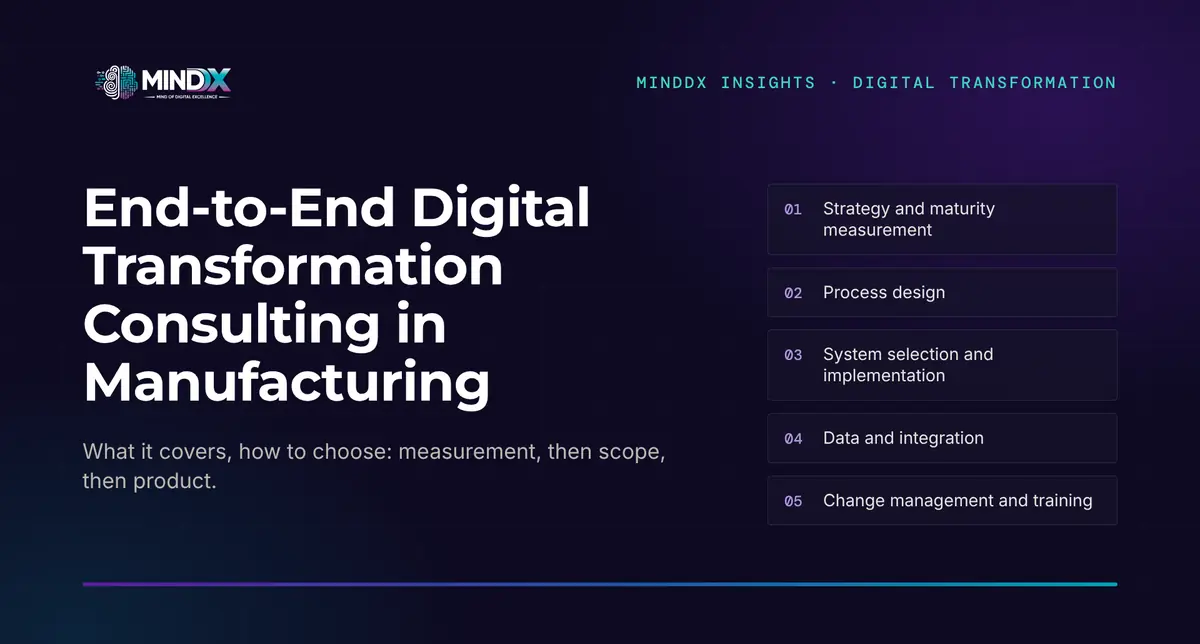
An end-to-end consulting engagement usually addresses these five layers together:
- Strategy and maturity measurement: where the company stands today in processes, data, technology and organisation, and the priorities on the way to the target.
- Process design: modelling current and target workflows in a common language, for example BPMN.
- System selection and implementation: choosing and implementing systems such as ERP, CRM, MES and IIoT, planning and process mining according to need.
- Data and integration: making master data consistent and getting the systems to speak with the same data.
- Change management and training: making sure the teams actually use the new setup.
Each of these layers calls for its own expertise. What sets end-to-end consulting apart is that it manages all of them with the same scope and the same order of priorities.
Why does «end to end» matter?
In manufacturing, information flows from one system to the next: the sales order goes to planning, the plan to the shop floor, and shop-floor data back to cost and delivery dates. If one link in the chain is broken, even the best-implemented system works with incomplete data. For example, ERP may plan the work order correctly, but if actual times and scrap do not come back from the floor, cost is still an estimate.
Another cost of fragmented projects is accountability. When each system has its own provider, the gap between the systems is nobody’s job. In the end-to-end approach, that gap is written into the project scope from the start.
How to choose a consulting firm
When comparing proposals, look at the way of working more than at the presentation. The questions below separate two approaches that carry the same name:
| Question | Product-first approach | Measurement-first approach |
|---|---|---|
| Where does the work start? | Product presentation and demo | Measuring the current state and analysing processes |
| How is the scope set? | From a list of modules | By matching processes to needs (Gap / Fit) |
| What is the price based on? | Estimated man-days | The validated scope |
| Whose job are the links between systems? | Undefined, or a separate project | Part of the scope |
| Where are change and training? | At the end of the installation | In the plan from the start |
| How is success measured? | By the system going live | By the system being used in the process |
The answers to these questions say more than the total on the proposal. To compare proposals line by line, see our article on five critical line items in an ERP quote.
The right order: measurement, then scope, then product
The most expensive mistake in transformation projects is choosing the product before the scope. When the product comes first, processes are bent to fit it and the gaps only surface once implementation is under way. The right order has three steps:
- Measurement and scope: maturity is measured, processes are reviewed, needs are matched with candidate solutions and the scope is put in writing. At MindDX this step is Assess.
- Implementation: the chosen system is implemented to the validated scope and connected to the processes. At MindDX this step is Implement.
- Continuous improvement: the use of the new setup is followed, and new needs are measured before they are added. At MindDX this step is Transform.
Pitfalls to avoid
- Mistaking software for transformation: a new system may do no more than run the old process faster.
- Leaving master data to the end: if items, bills of materials and routings are inconsistent, every integration carries the wrong data.
- Starting without a written scope: without a written scope, budget and timeline are not written down either.
- Involving the teams late: if the people who know the process are not part of the design, the system will not be used.
- Looking for support programmes at the last minute: public programmes for digitalisation, such as those of KOSGEB in Türkiye or the European Digital Innovation Hubs in the EU, open through periodic calls; check eligibility in the institution’s own current announcements before the project starts.
The MindDX approach
MindDX runs digital transformation in manufacturing companies in the order Assess → Implement → Transform. The work starts with a maturity measurement on the MindDX Platform; processes, systems and data are reviewed together; and the implementation scope is written into the Validated Scope document. Solutions such as ERP, CRM, MES and IIoT, planning and process intelligence are chosen and implemented to that scope.
To see how the measure-first, decide-second approach works, explore the MindDX Platform.
Sources
- Object Management Group — Business Process Model and Notation (BPMN)
- ISA — ISA-95 Standard: Enterprise-Control System Integration
- Prosci — The ADKAR Model
- KOSGEB — Small and Medium Enterprises Development Organization of Türkiye
- European Commission — European Digital Innovation Hubs Network
- NIST — Manufacturing Extension Partnership (MEP)